Newser reported that on a new ranking of research at universities round the world, Harvard dropped to #3, and China won not only the top two spots, but 8 of the top 10, with universities unheard of by me. I added a comment to the story:
Showing posts with label China. Show all posts
Showing posts with label China. Show all posts
Saturday, January 17, 2026

Wednesday, April 30, 2025
From RT - CHINA'S MILITARY CAPABILITY
I include this article because it mentions wars in recent history about which I know nothing. In discussing the Peoples Liberation Army, that includes the nave, and the article does not include China's aggression against the Philippines in the South China Sea. Still, it is a short article that opens possible research into many little known battle spheres. I hope you find it informative. Hugh Murray
Think China is a ‘nation that can’t fight’? Think again
The West has mocked Beijing’s military for decades – it may soon regret it

The internet is flooded with quotes attributed to Chinese philosophers. Who hasn’t seen a meme with a “Confucius” saying or heard of the so-called “ancient Chinese curse” about living in interesting times? In reality, 99% of these quotations are fake, reflecting Western projections of Chinese wisdom rather than its reality. Yet one saying – “good iron does not make nails; good men do not make soldiers” – is genuinely Chinese. Known since at least the Song Dynasty (late 10th – early 12th century), it remains in use today, much to the irritation of China’s People’s Liberation Army (PLA) political officers.
Globally, the proverb helped fuel a myth that China “never liked to fight” and “always lost wars.” Yet the absurdity of this view is clear if one simply looks at the world map today. Nevertheless, it persists – and now, as China becomes a true superpower, this misconception could have dangerous consequences for the world.
Historical roots
To understand the proverb’s origin, we must look at the structure of the Song Dynasty's military. Early Chinese empires such as the Han relied on conscription, but over time, mercenary armies became the norm. Chronic shortages of volunteers were addressed by drafting criminals and debtors – turning armies into collections of society’s “undesirables.”
Officers, by contrast, came from privileged classes who passed imperial military exams. These exams, though less prestigious than their civilian counterparts, still conferred status. But it is crucial to remember that the civil bureaucracy was tiny, making its officials extraordinarily powerful, while rank-and-file soldiers remained socially degraded.

This pattern closely resembled Europe in the 17th and 18th centuries: a privileged officer corps and low-status, often criminal, enlisted men. Wellington’s remark in 1811 that “only men of the worst character enter the regular service” could have been said about China too. Military service was a punishment; soldiers were feared more for their misbehavior than admired for their valor. In that context, the “men and nails” proverb made perfect sense – and was hardly unique to China.
The modern Western glorification of the soldier – tied to mass conscription, nationalism, and industrial militarism – only emerged in the 19th century. In China, where social and political backwardness lingered longer, this transformation began only in the 20th century with enormous difficulty.
China’s true military record
A regular, centrally commanded, professionally trained army – the PLA – was only created in the 1950s, after the Communist victory. Almost immediately, the PLA demonstrated its effectiveness by intervening in the Korean War, inflicting a series of defeats on UN forces and saving North Korea. The Soviet Union, by contrast, limited itself to sending small air and anti-aircraft units.
In 1962, China launched a well-timed, surprise offensive against India, achieving a quick victory and territorial gains. Beijing struck while the world was distracted by the Cuban Missile Crisis. Throughout the 1960s, China also provided major military support to North Vietnam, at times deploying up to 170,000 troops – considerably more than the Soviet Union ever committed.
In 1969, Beijing provoked and fought small border clashes with the USSR – a calculated show of strength aimed at achieving key foreign and domestic policy goals, including paving the way for rapprochement with the United States. The military component was minor; the political impact was enormous.
Meanwhile, the PLA fought a prolonged counterinsurgency campaign in Tibet, defeating US- and Indian-backed guerrillas by the early 1970s. It also engaged in recurring military action against Taiwan, demonstrating clear superiority across the Taiwan Strait.

Risk-taking and adaptation
In February 1979, China launched an invasion of Vietnam, a newly minted Soviet ally. This bold action risked conflict with a nuclear superpower. The campaign exposed PLA shortcomings but also demonstrated its resilience, willingness to absorb heavy casualties, and ability to carry out major offensives.
While Vietnam held out thanks to Soviet military threats against China, Beijing’s ability to act – and to compel both Moscow and Washington to recalibrate their policies – was a major achievement.
The Sino-Vietnamese conflict evolved into a decade-long border war marked by artillery duels, naval clashes, and raids, culminating in China’s decisive naval victory in the Spratly Islands in 1988.
Comparing China’s record from 1949-1989 to the Soviet Union’s reveals a striking fact: China used military force more frequently, and arguably more effectively, than the USSR during the Cold War.
Modernization and patience
After Mao’s death, the PLA underwent profound modernization, both politically and socially. Military service gained prestige. During the Cultural Revolution, the army became a pillar of governance and society. Yet, China’s foreign policy turned defensive from the 1990s onward – not from weakness, but from strategic calculation.
After the Soviet collapse, China faced a unipolar world dominated by the United States. Survival and development required patience. Beijing avoided major military engagements for nearly 30 years, instead focusing on economic and technological breakthroughs. Shows of force were reserved for defending “core interests,” such as during the 1995-1996 Taiwan Strait Crisis.

By the late 2010s, the global environment had changed. American dominance weakened. The unipolar order eroded. China’s rise, both economic and military, became undeniable.
Beijing’s gradual reassertion of military power has been cautious but unmistakable: expanding operational reach, forging military partnerships, and conducting exercises in potential conflict zones.
A dangerous myth
The myth of Chinese military incompetence is not only historically false; it is potentially catastrophic. In the past, underestimating China’s capabilities led adversaries to miscalculate – to their great cost. Today, as China carefully prepares for its first major combat operations in decades, its adversaries would do well to shed illusions and study history more carefully.
Beijing will not rush into war. It will act only under conditions it judges favorable and under circumstances it has painstakingly prepared. But make no mistake: when it acts, China will not be the passive, incompetent power that outdated stereotypes imagine.
This article was first published by the magazine Profile and was translated and edited by the RT team.
Sunday, April 20, 2025
FROM RT - DEPRESSING NEWS FROM CHINA
I saw nothing about this on today's news in America, but I do not watch all the programs. This is not the news I expect on Easter, or any day for that matter. Hugh Murray The RT story is below:
China detonates non-nuclear hydrogen bomb — media
The South China Morning Post has cited researchers as saying the 2kg magnesium hydride device generated a 1,000 degrees Celsius fireball

Chinese researchers have successfully tested a non-nuclear hydrogen bomb that created a sustained fireball, far outperforming traditional explosives, the South China Morning Post has reported.
In an article on Sunday, the newspaper cited the researchers’ study published last month in the Chinese-language Journal of Projectiles, Rockets, Missiles and Guidance. According to the report, a team from the China State Shipbuilding Corporation’s (CSSC) 705 Research Institute — a key player in underwater weapon systems — developed a 2kg (4.4lbs) bomb primarily composed of magnesium hydride, with conventional explosives serving as the catalyst.
In a field test, the device reportedly generated a fireball with temperatures exceeding 1,000 degrees Celsius (1,832 degrees Fahrenheit) that lasted for more than two seconds, which is "15 times longer" than what an "equivalent TNT blast" is capable of producing.

In the reaction, magnesium hydride, a compound originally developed as an efficient fuel, rapidly releases stored hydrogen gas, resulting in a sustained inferno.
The novel explosive device’s destructive power thus is said to lie not in its blast pressure, but rather in the ability to generate extreme heat.
The South China Morning Post quoted CSSC research scientist Wang Xuefeng as explaining that its properties also allow for “precise control over blast intensity, easily achieving uniform destruction of targets across vast areas.”
If fully developed, the method could presumably yield a weapon similar to a thermobaric device – ideal for annihilating defensive structures and armored vehicles.
While the production of magnesium hydride used to be mostly small-scale and rather complicated, China has recently developed a cheaper and safer production method and built a plant capable of producing 150 tons of the compound per year.
You can share this story on social media:
Sunday, December 17, 2023
US and P. R. CHINA BOTH COURT VIETNAM
The following article, from RT, is informative not only about the visit of China's leader, Xi Jinping, to Vietnam, but aabout the situation of Vietnam being courted by both the USA and P. R of China. Though RT asserts that the views expressed are solely those of the author, Rimur Fomenko, that author wrote an article worth pondering. Hugh Murray
18 Dec, 2023 00:59
This Asian nation is key for the US-China power struggle
Vietnam has found itself in the position of kingmaker, being crucial for the plans of both Beijing and Washington for Asia

Chinese leader Xi Jinping has just paid an official visit to Vietnam, where he met with the leaders of Hanoi’s ruling Communist Party. Xi hailed the ties between the two countries and vowed to take them to the next level, while numerous business agreements were also signed.
Such a move would seem obvious given the two countries are not only neighbors, but share the same political ideology. However, their relations are more complicated than that.
Three months earlier, Vietnam was visited by US President Joe Biden of all people, who succeeded in elevating America’s relationship with the South East Asian nation to a strategic partnership. Then, just weeks ago, Japan did the same thing. When looked at from this angle, Xi’s overtures to Hanoi do not look as powerful, but rather represent one of a series of voices from larger powers seeking to win hearts and minds in Vietnam, a nation of geopolitical significance which will contribute to the outcome of the power struggle in the Asia-Pacific.
Although Vietnam is a communist state, this does not mean its relationship with Beijing is amicable. While of course it is not openly antagonistic or hostile, grassroots opinion in the country is wary of China, because a great deal of Vietnamese history involves a power struggle to maintain its independence from the Chinese imperial dynasties.
Vietnam, like many Asian nations, derived a great deal of cultural, philosophical, and technological capital from China, yet its national identity has always been premised on being a distinctive nation from China and not being politically dominated by it. Ideology is not relevant here.
Vietnam recognizes that China is its most critical economic partner – on the other hand, it is striving to avoid ‘Chinese hegemony’. This is not just historical, but modern as well. In 1978, China invaded Vietnam in order to break its alliance with the Soviet Union and assert dominance over it.

Not only that, the two countries also have rival claims in the South China Sea, a contested waterway with critical shipping routes and resources. From Hanoi’s considerations, this leads to a foreign policy of non-alignment which seeks to court multiple foreign powers, including the US, to maximize its own strategic benefits.
How, one may ask, can Vietnam possibly court the US given the history between the two? Can Hanoi trust Washington? Vietnam appears to be confident in its relationship with the US, despite the scale of atrocities committed during the Vietnam War, because Hanoi won that conflict on its own terms and reunified the country.
Given this, Washington is now returning to the table because it sees Vietnam as a partner to try and contain China. Sure, Hanoi has ideological and political reasons to be suspicious of it, and the White House can never be an ‘ally’, but what the US offers is a chance to accelerate Vietnam’s own economic development and also increase its military leverage in the abovementioned dispute with China.
Of course, Beijing sees this, and therefore the resulting outcome is a struggle for Hanoi’s loyalty. This means, however, that China increasingly has to offer more to be allowed to ‘be at the table’ and compete with the other powers, and also that Vietnam gets to set the terms of engagement and be ‘the kingmaker’.
From the Chinese perspective, Vietnam is in fact an important aspect of the global trade and supply chain because it provides a mask to conceal the ‘made in China’ label to get around various trade restrictions and tariffs imposed by the US. Many Chinese companies are investing in Vietnam precisely because of this, which is why Chinese trade with ASEAN as a whole has surged to replace trade with the US.
Chinese companies build key parts and components, ship them to their own factories in Vietnam where assembly is completed, and the product then goes to the US. It creates the deception that ‘made in China’ is going away and allows indirect Chinese trade with America to continue. Thus, the integration of the Vietnamese and Chinese economies is accelerating. This is enough to keep the peace between the two countries.
At present, given US military encirclement, China is not in a strategic position to engage in confrontation with Vietnam, which is why Xi has chosen to throw everything at it in the name of diplomacy. Keeping Vietnam as a neutral and non-hostile neighbor is thus a core priority for China, especially given the fundamental foreign policy doctrine of the US to instigate division between Beijing and its neighbors as a means of containment. Vietnam, however, simply wants the best of all worlds, and it is certainly getting it for now.
The statements, views and opinions expressed in this column are solely those of the author and do not necessarily represent those of RT.
Saturday, August 12, 2023
RT ARTIC;E ON CHINESE WEAPONS IMPROVEMENT - LASER COOLING
This article comes from RT.
12 Aug, 2023 21:14
China makes weapons ‘breakthrough’
Beijing’s military scientists have claimed success in enabling high-energy lasers to operate “indefinitely” without overheating

Chinese military scientists have reported a research breakthrough that could make it possible for Beijing to develop high-energy laser weapons that can shoot for as long as their operators desire, without interruption and without any degradation in performance.
Scientists at the National University of Defense Technology in Changsha, China, published the results of their research earlier this month in Acta Optica Sinica, a peer-reviewed Chinese journal. They claim to have developed a new cooling system that makes it possible to operate high-energy lasers “indefinitely,” without any effects from overheating.
“This is a huge breakthrough in improving the performance of high-energy laser systems,” the team said in its research paper. “High-quality beams can be produced not only in the first second, but also maintained indefinitely.”
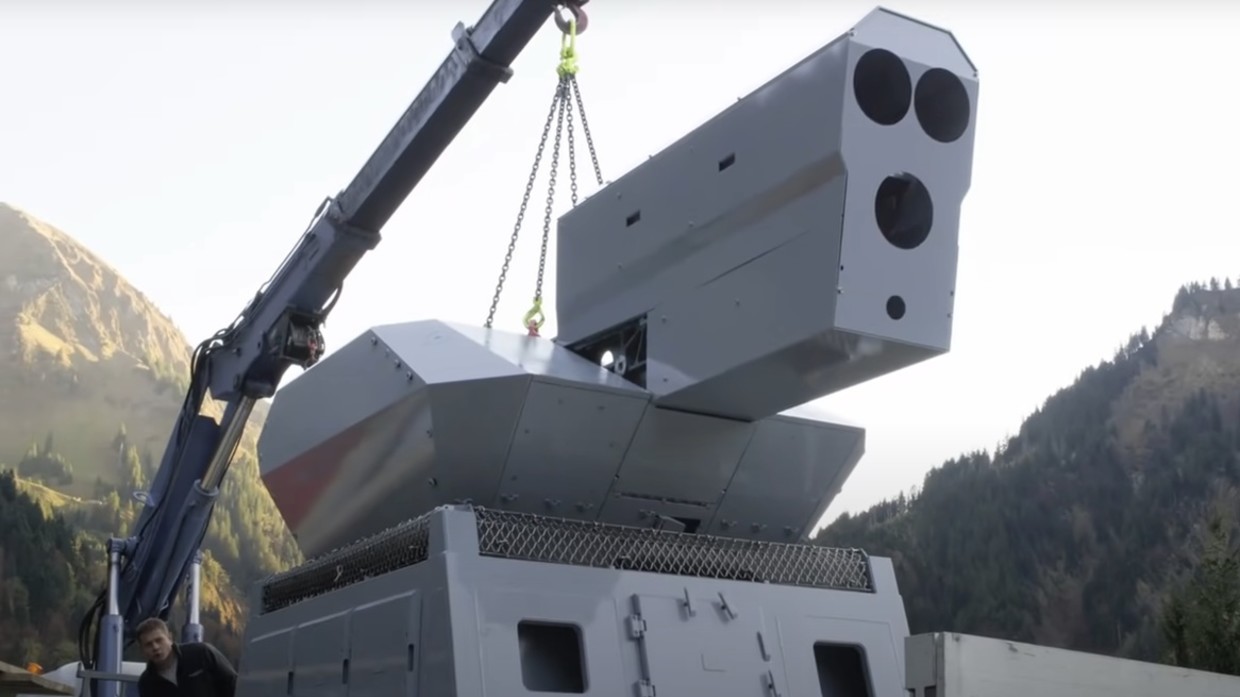
The cooling system controls gas flows to remove heat from inside a laser weapon, preventing vibration and disruptions in performance. It can enable longer operation, increased range and greater firepower, the scientists said. They noted that 60 years on from the invention of the first ruby laser, weapons developers haven’t been able to create “death rays that can instantly kill targets.”
Some of the most high-profile US laser weapons projects have been canceled, despite shooting down targets in testing. “The true reason for the cancellation of these projects was that their destructive power did not meet expectations,” the Chinese scientists said. Longer, continuous operation times are needed to extend the range of laser weapons beyond a few kilometers, they said.
Such weapons generate high-energy beams that heat up the gas in their path as they pass through the air, creating turbulence. This effect can distort the beam, diminishing its accuracy and strength. The heated gases can also contaminate the mirrors in a laser weapon, reducing performance and potentially damaging a system.
The Chinese researchers said they developed a system that blows gas through the weapon to remove waste heat and keep the mirrors clear. Their technology is already being used in a number of laser weapons that the Chinese military has under development.
Beijing reportedly intends to use such weapons against drones, missiles and aircraft. They also could be used to target satellites, disrupting enemy communications, navigation and surveillance capabilities.
Tuesday, March 8, 2022
THE “NEAR SPUTNIK MOMENT” - REFLECTIONS
By Hugh Murray
After China launched its hypersonic missile in July 2021, one which circled the globe and returned to China to come close to its target, American Gen. Mark Milley called it a “near Sputnik moment.” America had been shocked by the Soviet launch of its first satellite into orbit in 1957, and America's military is similarly stunned by China's rapid advance in hypersonic technology that may be a game changer in the military balance of power. Such missiles, traveling at 5-times the speed of sound, might sink our air-craft carriers before radar could detect, much less destroy, the incoming projectiles. I described this in my previous blog post, a review of Andrei Martyanov's DISINTEGRATION. Here I shall discuss other aspects of this “new” sputnik.
When the original Sputnik first orbited, much of America was truly shocked, as there was massive media coverage of the new moving star in the night sky. In 1957 America was enjoying unheard of prosperity in the history of the world. We were #1. The Great Depression of the 1930s was over; the sacrifices of WWII, the loss of lives, the shortages, the rationing, all seemed to end with Allied victory. The fears of a post-WWII depression proved wrong. True, some like the appliance makers Powel and Lewis Crosley, who in 1920 introduced a cheap radio and soon became the world's largest radio manufacturer, a few years later owned the world's most powerful radio station of 500 thousand watts, and in 1939 introduced a cheap, compact car, sold at department stores. Thinking there might be an economic downturn, Crosley returned to its small, cheap, compact autos after the war while competitors issued larger, more comfortable vehicles. By the early 50s Studebaker introduced its airplane influenced auto (which did not sell well), but the Crosley disappeared. Others added more chrome. Bigger, speedier, with cheap unrationed gas, America was on the go. And real estate developers were attracting them to the new suburbs, combining the airiness of the country with nearness the city with access by the big cars. Pres. Eisenhower, who helped defeat Germany, was impressed by its autobahn. Under Ike the federal government invested huge sums to build a national highway system in America.
Most factories and people transitioned well from armed services and war work to new peace-time employment with good wages. At first, they were rare, expensive, perhaps seen inside a bar or a special place, but prices of the new televisions dropped, soon they were the new entertainment center, and inside the home. Air-conditioning changed the South from people sitting out on the porch, to inside watching TV. Kitchen appliances changed house work, as women who had had their first jobs during the war were replaced by men, but found house work easier. These appliances provided VP Nixon ammunition to defeat Khrushchev in the famous kitchen debate in Moscow. America was clearly #1, and living better then any other people in the history of the world.
While all of this was happening, our image of Russia and the USSR was of the dark, dreary, poor dictatorship, backward in everything – except weapons, propaganda, brainwashing, and spying. The only reason they had the A bomb and H bombs was because spies had given them our secrets. The Russians surely could not have done it on their own, Americans concluded.
This is why Sputnik 1957 was such a shock. How could they steal this from us, if we did not have it at all? How could a land of shoddy, simple products beat the US into space? It made no sense. Then, the first explanation – it was the Germans, the German scientists captured after WWII and taken to the Soviet Union, it was they who gave the Russians the ideas and technology to create Sputnik. When America responded by placing in orbit a tiny baseball sized satellite, an American cartoonist portrayed the 2 satellites passing each other in space, and speaking to each other in German. Of course, one of the leaders of the American space program was Werner von Braun who had helped develop the V-1 and V-2 rockets for the Reich.
Americans quickly realized we were in a new area of competition with the Soviets – space. And we were behind. America responded. Schools placed more emphasis on math and science, universities gave more scholarships in these fields. Nerds gained esteem. Politicians got in the act, and in the 1960 Presidential debate between Nixon and John Kennedy, the Democrat accused the Republicans of allowing a missile gap to develop. (It may not have been true, but after Sputnik, it was credible). Kennedy won, and promised America that we would be first to the Moon. And in 1969, just 12 years after beginning late and behind, America landed a man on the Moon; we won the race.
By contrast, the Chinese hypersonic missile feat of 2021 has received little publicity in America. And it is not just the news of 2021. On 7 March 2022 Tony Capaccio wrote for Bloomberg News, “U.S. Efforts to catch up with China and Russia in developing hypersonic weapons may be set back after Lockheed Martin Corporation's air-launched missile suffered 3 consecutive test failures that left it on a tight schedule.”
On 1 December 2021, when VP Kamala Harris addressed the new Space Force, she stressed that the new priority should be, nothing to do with hypersonic weapons, but climate change. She also wanted to get more students into the STEM courses.
But unlike the 1950s, can America's new educational establishment accommodate getting the best students into STEM?
At a recent televised press conference of the Milwaukee Bucks basketball team, one player declared how proud he was of the diversity there as he looked to the others being filmed. They were all black players. Diversity once met varied, but in some areas of America now, it means people of color, or simply blacks. The left proclaims Diversity is Our Strength. If it were an all-black squad, this would violate the rules set by government in other areas of life, like the workplace and university enrollment. To the government, diversity is quotas in one form or another promoting proportionality in most fields. Should quotas be enforced to require diversity on basketball teams? Whites are still a majority nationally. So each major basketball team should have a majority of white players. About 20% Hispanic, 14% Black, and about 6% Asian. If this were required of all basketball and football teams, would it improve the play of the teams? Their standing? Each team would decline in skills and play as diversity was imposed.
So why do we play this quota game in corporations, and especially at major universities? And even more and more in the STEM departments?. Do you think this will improve those departments? Make them more able to catch up with China? In the 1950s, universities were allowed to choose the best qualified students. Any could apply at some excellent schools, and most accepted were white males. And America got to the Moon before the Soviets. Filling seats in hard subjects with lesser qualified candidates, simply because they are black, Hispanic, trans, women, Amerindians, deprives the department of the best qualified, and will result in resentment by the quota people who cannot follow what is happening, and encourage racism and sexism in the truly qualified, who observe that some quota hires cannot keep up.
If America wants to win the hypersonic race with China and Russia, we should engage with our best performers, not those who did poorly but fit the race or gender requirements of our politically correct comisars. Racial and gender favoritisms holds America back. And we are in a serious race for survival. Restore merit and the color blind ideal; end racial and gender quotas, preferences, disparate impact law, diversity, and equity. Those are all terms for racial and gender discrimination. If we return to merit, we have a chance against Russia and China. We have a chance to win.
Why is the new hypersonic Sputnik important?
The perfect storm may be on the horizon. From the time of the Nixon and Kissinger trip to “open” China in 1972, a major objective of American foreign policy has been to split the USSR and China. Russia and China surely had their differences, so generally the American policy was successful, until recent years. With the fall of the wall, the Soviets withdrew its forces from the east European nations and the West pledged not to expand NATO beyond the Elbe River. However, NATO did expand to Poland and other former members of the Warsaw Pact. As the book RED HANDED shows, many influential American politicians were less worried about China, because they were being heavily bribed, directly or indirectly. The Biden family had received a large sum, through Joe's son Hunter, from the Ukraine. When Putin invaded the Ukraine in 2022, Pres. Biden and the West strongly favored Ukraine.
Before the invasion, Putin attended the Opening Ceremonies of the Beijing Olympics in February 2022. He may have dozed for part of the event, but the visual was the reality – Russia and China stood together. American policy of keeping them apart seems to have failed. China is still not condemning Putin's thrust into Ukraine. Ukraine as a distant nation means little to the United States. Even if Russia would annex all of it, that would not change the balance of power. But America needs Taiwan to remain independent from mainland China. Taiwan has only been a part of mainland control for about 2 years since 1894. China sees Taiwan as part of its territory, and America agreed to a one-China policy when Nixon went to China and Carter confirmed it later in the 1970s. We divided China from Russia, but at the same time we were seemingly pulling the rug that held up the island nation, abandoning Taiwan to the mainland.
In recent years China made vast claims on the South China Sea, built up islands there and militarized them. China overtly threatens the Philippines and Vietnam and other nations on that sea. There is a string on non-Communist nations, South Korea, Japan, Taiwan, Philippines, and then down to Australia and New Zealand. If Taiwan falls to Communist China, the chain is broken. If Taiwan falls, it is a main producer of computer chips, and our production of many products will be disrupted. If Taiwan falls, it will be treated as Hong Kong, with no democratic freedoms. Even though legally, we may have a weaker case, militarily, we must not let it fall to the repressive Chinese Communist Party.
The new Putin-Xi alliance makes it more difficult to contemplate a war we may have to fight – for Taiwan and for free Asia, and for ourselves. Ukraine will not change the balance of power much either way. Taiwan will. Many of our politicians are bought by Beijing. Will we be prepared for the storm that is coming?
Monday, June 25, 2012
US OPEN DOOR IMMIGRATION - WHY?
Because I am delayed in writing my piece on immigration, I include this provocative piece by Gwynne Dyer, who appears to be writing from Vancouver. It is a most interesting piece, and I shall be referring to the ideas in this article in my article, still to be written.----------Hugh Murray
Gwynne
Dyer, Straight, June 5, 2012
What if
China, flush with its new wealth, opened its doors to mass immigration? It
would make sense from an economic and social point of view, because its
one-child-per-family policy has produced a young generation far smaller than
the one that now does most of the work. China’s population is “aging” (i.e. its
average age is going up) faster than any other country in history, and it could
certainly do with some more young people.
If it
had an immigration policy like that of the United States, it could fill all the
gaping holes in the workforce that will open up when the present adult
generation retires, and there would be enough people working and paying taxes
to support that older generation in its “golden years”. Otherwise, there will
be barely one worker for each retiree, and their post-retirement years will be
far from golden.
So
let’s suppose China opens the gates. (Stay with me on this.) The immigrants
would come, from all over the world. Probably most would be from south and
south-east Asia (India, Pakistan, Burma, Indonesia, the Philippines), but
plenty of Russians would come too. So would Arabs from the slums of Cairo, and
Congolese from the slums of Kinshasa, and Mexicans fleeing the bloody war on
drugs.
{snip}
They
would all come, and China would be transformed. In 50 or 60 years it would be
one of the world’s most diverse societies. Almost all the new immigrants would
learn to speak some Chinese, of course, but their children would be fluent in
the language. Indeed, they would think of themselves as Chinese, even though
their skins were white, brown, or black and their religions Muslim, Christian,
Buddhist, or Hindu.
Some
tens of millions of them would already have intermarried with ethnic Chinese,
if only because there are tens of millions of young Chinese men who will
otherwise remain unmarried. (The Chinese have been killing too many of their
baby girls.) And everybody would live more or less happily ever after.
I know.
It’s never going to happen, because the Chinese would never let it happen. But
that’s precisely the point. The Americans have let it happen. Why?
I’m not
saying it is a bad thing. Personally, I like it. But it is an extraordinary
thing. Sixty years ago the United States was a country whose population was
overwhelmingly of white European descent. The only really big minority was the
black and mixed-race descendants of African slaves, who accounted for about
one-eighth of the population. And then the United States opened the gates very
wide.
Last
month, the U.S. Census Bureau revealed that non-white births in the country
narrowly exceeded the number of births to white Americans for the first time.
{snip}
{snip}
So why
did the last two generations of Americans, who were still mostly of European
descent, let it happen? Did they welcome and encourage it, as a good thing for
the country’s future? Or were they just asleep at the wheel?
Some
Americans certainly did encourage it, arguing that turning the United States
into a microcosm of the whole world was fulfilling its destiny, and that the
sheer diversity of its future population would give it a huge competitive
advantage in the world. But there were not many people who made that argument,
and there is actually little evidence to show that ethnic diversity makes a
country more competitive.
Nor did
this immense change happen while the old white population was just not paying
attention. There were debates about immigration policy all the time, there was
plenty of information about where the current immigration policy was leading,
and Americans simply let it happen.
{snip}
Maybe the
last two generations of Americans were a lot less racist than many
people—including many Americans—thought. Or perhaps they were all silently
aware that only 500 years ago, none of the births in North America were white.
Subscribe to:
Posts (Atom)