Featured Post

WHITE SLAVES IN AFRICA - STOPPED!

THOMAS JEFFERSON AND THE TRIPOLI PIRATES: THE FORGOTTEN WAR THAT CHANGED AMERICAN HISTORY (New York: Sentinel, 2015) by BRIAN KILMEADE ...

Showing posts with label FBI. Show all posts

Friday, June 16, 2023

MUST SEE MOVIE - RICHARD JEWELL

My mouse broke over the weekend, and I could not get on the computer for several days. Saturday night I spent more time on the tv, and to my surprise, TNT was about to show a film that opened a few years ago, Richard Jewell. I had wanted to see it back at the opening, but a friend who usually took me to the mall had returned to his home country, and I had no easy way to get to the theater. Then lock-downs, and it was not front burner. I had heard it was on Amazon Prime, joined a month, but could not find it. So, forgot about it. So glad I got to see it. It concerns a flawed young man with a good heart. He believes in law and order and aspires to be a policeman or some how involved in law enforcement. He lives with his mom in Atlanta, and the Olympic Games are coming to the Georgia city. During some musical entertainment, he spots an unattended package, unsure. thinks it might be an explosive, gets people out the way as much as possible, and the bomb goes of killing a few. He becomes a hero. The FBI then thinks he fits their profile as the bomber! They decide it is him. With help from the media, they go after him, destroy his reputation, get him fired, and unhirabe. Ruin a good man - the role of the FBI and the government in this case. A FEW DAYS BEFORE, FORMER PRESIDENT TRUMP HAD TO APPEAR IN COURT IN FLORIDA ON CHARGES INCLUDING ESPIONAGE. All the Biden documents, all the Biden bribery allegations, are ignored, while the US government now goes out to destroy Trump. Sad. See the movie, Richare Jewell. Hugh Murray

Tuesday, May 23, 2023

ROBERT KENNEDY, JR. DENOUNCES FBI TACTICS AGAINST CANDIDATE AND PRESIDENT DONALD TRUMP

 The following comes from RT, so take with a grain of salt.  However, today the FBI refused a subpoena from the Congressional oversight committee about its mishandling of the Hunter Biden laptop and the information it contained about the Biden crime family.


23 May, 2023 18:19

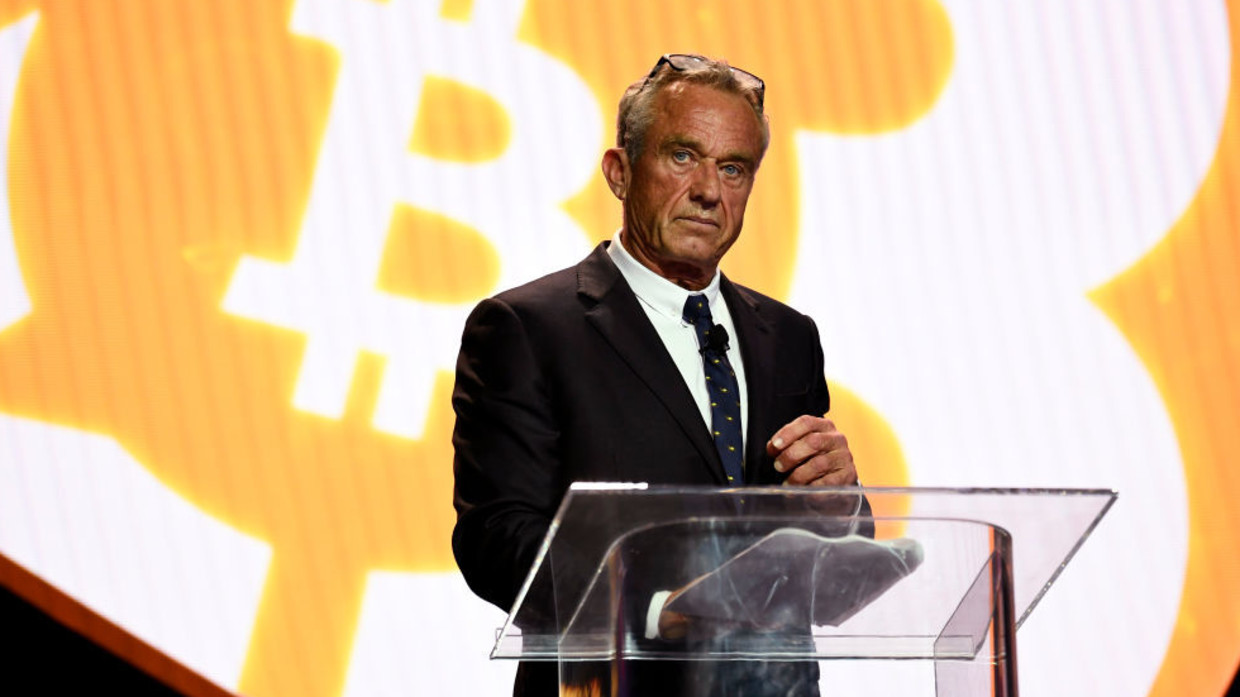
Robert F. Kennedy Jr. decries ‘weaponization’ of FBI

The US presidential candidate has claimed the agency tried to destroy Donald Trump, undermining democracy
Robert F. Kennedy Jr. decries ‘weaponization’ of FBI

US Democrat presidential candidate Robert F. Kennedy Jr. has broken ranks with his party by arguing that the FBI was politicized to take down Donald Trump – both before and after he was elected president in 2016 – making a “mockery” of the US political process.

“This is no partisan skirmish,” Kennedy said on Monday in a Twitter post“It is about the political weaponization of the FBI to destroy a candidate and then a sitting president. It’s about a matrix of lies so elaborate as to make a mockery of the democratic ideal of an informed citizenry.”

Kennedy made his comments in response to last week’s release of the Durham Report, which concluded that the FBI violated its own standards in starting an investigation into allegations that the Trump campaign colluded with Russia to win the 2016 election.

Special prosecutor John Durham’s four-year probe found that the agency based its case on unverified allegations – leading to the ‘Russiagate’ investigation during Trump’s presidency – and became a funnel for disinformation from Democrat candidate Hillary Clinton’s campaign.

CNN and other US media outlets that touted the Trump-Russia allegations for years downplayed the Durham Report, calling the damning findings about the FBI a “whole big nothing.” Kennedy said the media’s role in the attacks on Trump was “maybe most troubling of all.” He added: “The Durham Report reveals the abject complicity of the mainstream press, which has yet to admit they were taken in by the big lie, propagated it and now continues to permit those lies to stand as truth.”

Kennedy is a nephew of former President John F. Kennedy Jr. and son of 1968 presidential candidate Robert F. Kennedy, both of whom were assassinated. Earlier this month, he claimed that the FBI was behind the 1963 murder of his uncle and was likely involved in the killing of his father. He has a history of anti-establishment viewpoints, such as speaking out on the alleged dangers of some vaccines, calling for the release of WikiLeaks founder Julian Assange, decrying Washington’s escalation of the Ukraine crisis, and criticizing the US military industrial complex.

Kennedy likened the media’s handling of Russiagate to its support for false allegations by former President George W. Bush’s administration that Iraq possessed weapons of mass destruction. He called the two narratives “mendacious mythologies,” saying they were “lies, lies and more lies.”  

Wednesday, January 6, 2016

HERBERT APTHEKER'S BIOGRAPHY

“THE MOST DANGEROUS COMMUNIST IN THE UNITED STATES:”
A BIOGRAPHY OF HERBERT APTHEKER (Amherst and Boston: U. of Mass. Press. 2015)
By GARY MURRELL. Afterword by Bettina Aptheker
Rev. by Hugh Murray
            At the rigged CP convention in Cleveland in December 1991, Gus Hall was determined to retain control of the shrunken CPUSA.  Surprisingly, on the second day, the Hall faction permitted Herbert Aptheker, by then a dissident, to speak for 5 minutes.  Murrell, using the speaker’s notes of the convention, includes some of that speech: “That [the secret financing of the CPUSA] was outrageous.  I had spent much of my life denying it,…under oath,…and the party leadership knowing that what I was saying was not true and what the government was saying was true.  But we did not know that.  We denied that…Gus [Hall] knew it, and supported it, and Gus was paid for it.  Gus was on Moscow’s payroll…”(p. 333)  It seems that when Aptheker was called as an expert witness in Communist Party trials, he was not so expert at all.
            Murrell describes Aptheker’s roll in the Smith Act trial of Communist leader Steve Nelson.  On the witness stand Aptheker discussed Marxism and its approach to armed rebellion, and he was cross-examined by the prosecution.  Aptheker was asked to elaborate on the Marxist view of armed revolution.  (102-104)  This 1951 trial is part of the McCarthy era’s anti-Communism, and included in the chapter “Are you now or have you ever been?”  However, in April 1943 the FBI had bugged Steve Nelson’s Oakland, Calif., home and overheard the visit there by a member of the Soviet embassy give Nelson money from the Soviet Union for the CPUSA.  The Soviet official also gave Nelson instructions for the hiring of Communists who would be assigned posts in the newly created Manhattan Project, whose aim was to create an atomic weapon.  This FBI bugging may have provided the agency with its first knowledge of the Manhattan Project and the American attempt to build the bomb, and clearly the Soviet interest was in planting agents who would supply the Soviets with reports on the progress of the atomic bomb.  The bug had provided the FBI with most important information about a conspiracy to commit treason.  When FBI Director J. Edgar Hoover then alerted an official high in the Roosevelt Administration about this plot to steal atomic secrets, that high official tipped off the Soviet Embassy that the FBI was on to them, essentially urging the Soviets to be more careful in the future and not be caught!  In the words of Sen. Joseph McCarthy, “this was a conspiracy so vast.”  Meanwhile, Aptheker defended on the witness stand a Communist official who took Soviet funds for the American CP in order to place moles in strategic jobs to make it easier to steal American secrets in building the bomb for the USSR.  Murrell praises Aptheker for his enormous courage in standing up against Sen. McCarthy.  But on the big issue of that era, McCarthy was right; Aptheker wrong.  Moreover, about Nelson’s treason, did Gus know about that too?  Did the leadership of the CPUSA?
            Aptheker also appeared for the defense at the trial of North Carolina CP leader Junius Scales.(187)  Despite Aptheker’s testimony, Scales was convicted, served time, and quit the CP.  In his autobiography (written with R. Nickson) Scales concedes that he was never asked, but  wondered what he would have done if asked by the CP leadership to perform a treasonous act.  Aptheker never seems to have raised such serious questions about his own 5 decades of CP membership, in which he accepted and followed the discipline of the party.  This question never rises in his consciousness.  How far might he have gone?  Murrell is certain that Aptheker was totally dedicated to the Party; for him the Party was “everything.”(332)  If ordered, would he have spied?  Or what else?
            His daughter’s autobiography gained publicity when she alleged that Herbert had molested her for a decade, from age 3 to 13; from 1947 to 1957.  Far more damning, Bettina included a paragraph (p. 23 of her autobio) implying that Herbert had gone to Mexico to find the Mexican who had informed for the FBI and caused the capture of Gus Hall, then hiding underground in the belief that the US had turned toward fascism.  The clear implication of that paragraph was that Herbert, a recently discharged major from the US Army, had gone to Mexico to “find” the snitch and eliminate him.  Bettina’s paragraph presents the impression that the scholar, author, lecturer, theoretician Herbert Aptheker may well have been even more for the Party!  Murrell does not address Bettina’s paragraph directly; he simply reports that a couple of comrades had been stranded without funds after Hall was taken by the FBI.  Aptheker was asked to bring money to them so they could return to the US.(100)  So Murrell’s version is far more innocent – Aptheker is a Party bag man, not a Party hit man!  But, could not the Party have gotten funds to the 2 comrades in Mexico easier than by sending such a prominent Communist like Aptheker?  Does this make sense?  Smells fishy.
            As early as 1951 Aptheker was on the FBIs Security Index List of 12,000, and Murrell adds that Aptheker was considered one of the most dangerous – to be arrested in 1 hour if the order were given.(95)  If considered so dangerous, was his home bugged?  Was there anything to indicate a choo-choo train game?  Or any sounds of molestation by Herbert of Bettina?  Was there any bugging confirming why Aptheker went to Mexico?  Hard evidence might resolve the question of molestation far better than speculation about repressed memory or fantasies horrible or otherwise.  And did anything happen to the Mexican who provided information to the FBI about Gus Hall’s presence in Mexico?  If there is no hard evidence to support Bettina’s allegations, at this point, I now think Aptheker innocent of the molestation charge.
            On a short trip to NYC in the early 1960s I found the Jefferson Bookshop off of Union Square and chatted with a young woman clerk – Bettina – who informed me that her father was lecturing that night about a block away.  I went.  Herbert Aptheker so impressed me that I still recall something of that lecture 53 years ago.  His subject was that day’s New York Times.  I had attended Tulane U. in New Orleans, which had a large student contingent from New York, and they all boasted of the reporting in The Times.  Using that day’s newspaper as a text, Aptheker opined out the distortions and omissions on page 1.  I recall he pointed to a smaller article on that page about Vietnam; he said that the headline was not the important story.  What was important was in the 2nd paragraph, revealing the number of American military advisors then in Vietnam.  What was important, it was higher than the last previous count of American advisors.  The American Government was expanding its military efforts in Vietnam, he warned.  That was the important story.
            Aptheker was a most effective speaker, and he had a sharp mind.  Furthermore, he was a man of great courage.  He was a scholar who pioneered aspects of Black history, challenging the conventional wisdom of his day that slavery, contending that there were hundreds of slave revolts and conspiracies, that Blacks were important to the success of the Union in the Civil War, finding documents to encourage an interest in Black history and protest, writing and lecturing, editing, and finding a suitable publisher for the works of W. E.B. Du Bois.  Aptheker even ran for political office, and he established the American Institute for Marxist Studies, which he hoped might be a popular-front type of institution, providing information for various shades of the Left.  He did this and more even though blacklisted, and was denied any university teaching posts from 1946 (when he exited the army until 1969 when he finally got a part-time post at Bryn Mawr?  He was bitter about being blacklisted, but as Anthony Flood revealed in a recent article, Aptheker basically blacklisted C. L. R. James from all of his own writings.  James wrote Black Jacobins, about the slave revolts in Haiti, a topic similar to Aptheker’s own American Negro Slave Revolts.  But understand, how could Aptheker stoop to mention the book about Haiti?  C. L. R. James, the author, was a Trotskyist!
            Not only was Aptheker not provided a teaching post, he was often denied the right to speak on many campuses.  The FBI sought to prevent and disrupt his lectures, and a young Pat Buchanan also sought to do the same.  Aptheker had his critics in the CP, including some of the Black comrades who were jealous and resented that Du Bois had left his papers, etc. to Aptheker, and not to a Black.  The ex-Communist Harold Cruse vehemently denounced Aptheker in his Crisis of the Negro Intellectual.  Murrell reported that Aptheker only thrice answered the Cruse attack in print.(257)  That may be true, but Aptheker, as leader of AIMS, published my booklet on anti-communism and history writing, in which I devoted a section to an attack on Cruse’s intense Goebbelist, anti-Jewish rhetoric and interpretations,
            Once in the early 1970s while Herbert was opening the mail at AIMS, he saw the first page of a North Korean newspaper.  He held it up so I could see how the “dear leader” of that era was shown, almost as a deity.  Aptheker remarked, “There must be something about the Asian mind that wants a god-like leader.”  It was an off-the-cuff remark, and I do not mention this to be politically correct and accuse him of “racism.”  Indeed, a few years earlier in New York’s China Town I had seen a Chinese film that opened, not with a roaring lion, but with a large red background, in the center of which was a picture of Mao’s head, and from all round his head, like rays of the sun, gold flashes emanated.  Nevertheless, what stunned me upon reading Murrell’s book was Aptheker’s criticism of the CPUSA in the early 1950’s – he complained it was not doing enough to show the true nature of the life (how wonderful it was) in the USSR!  The early 1950s.  Stalin!  What even the CPSU would soon denounce as the cult of the personality!  And those cults were evident in all of eastern Europe.  The “dear leader” syndrome may or may not occur in Asia, but it seems intrinsinkly linked to Communism when it achieves power.  It was not “the Asian mind,” but the Communist minds that required such an adored leader.
            The Apthekers were involved personally with Angela Davis and her trials, figuratively and literally, in California.  At one point, in a hurried session with Angela in her jail cell, he proposed a possible line of defense – she was a member of the CP, the CP opposes individual acts of terrorism, therefore Angela Davis must be innocent of any complicity in the murder of the judge and others in the California courtroom.  Gus Hall’s Party leadership staunchly opposed this strategy.  To me it was like a syllogism, John is a Christian, Christians accept the 10 Commandments one of which is “Thou Shalt Not Kill,” therefore John cannot be a murderer.  But life is not a syllogism, and many Christians, Jews, Muslims, and Communists have been found guilty of murder.  Herbert also was more prone to defend criminal actions by Blacks under the notion that they were an oppressed people and therefore could not be gangsters. (279)  It probably made him unable to recognize the anti-white racism in crime when both he and his wife were mugged near their home in Crown Heights, Brooklyn.  Like Jews who fled for their lives from Hitler dominated Europe, leaving their homes behind, the Apthekers fled for their lives from the Black ghetto in Brooklyn.  Sociologists, infected by anti-white racism, naturally blame white racism for whites abandoning central cities.  In reality, many like the Apthekers had to flee for their lives from Black racist criminals.  Ideology blinded Aptheker, and the academedia complex, on such issues.
            Herbert Aptheker had many admirable qualities, and I did and still do admire him on many levels.  But he had a major flaw.  Even at the end, he seemed not to have gained wisdom from his treatment in the Party.  Murrell notes, had Gus Hall been in power in the US, Aptheker probably would have been executed for his opposition to Hall.(335)  But had Communist Aptheker been in power, how many would he have found necessary to eliminate?

            The flaw in Herbert Aptheker was his faith, his faith in the Communist Party.(300)  It was not simply a god that failed.  Failed?  Communism was a god that succeeded in many nations and the result was the murder of up to 100 million people.   All faiths are not equal.  For example, I now see Islam, with its barbarous sharia law, as a threat to Western civilization.  Communism, in its ruthless, brutal, and murderous demands for equality has also proved itself an enemy of Western Civilization.  Aptheker’s CP opened his mind in many areas, but the same CP closed it shut in many others.
                                           ADDENDUM
            While the mainstream press invariably referred to Herbert Aptheker as the leading “theoretician” of the Communist Party, there seems to be no valid reason for the media’s appellation.  Murrell quotes Dorothy Healy that the leadership of the CP viewed the role of intellectuals as simply to rationalize the Party line, whatever it might be.(143)  In effect, their role was no different from that of the Party troubadours, Pete Seeger, the Weavers, Woody Guthrie – to present and spread the Party line in artistic or academic formats.  As Aptheker became ever more prominent in defending Communists at trials, publishing Black history, ing lecturing to university gatherings, he became a rock star of the Party.  Perhaps not the best known Communist: the Rosenbergs and other spies made bigger headlines in a negative way.  Aptheker, however, presented a positive picture of the Party.  Gus Hall probably viewed Aptheker like the President views his official spokesman.  Unfortunately, for Hall, Aptheker was more independent than most Presidential spokesmen.
            Does a Presidential spokesman need to know about secret troop deployments here or there?  Clearly not.  That information is for the President and his closest advisors.  The media spokesman has to know only that which will make a more effective presentation of the President’s policy.  Indeed, more knowledge may make it more difficult for the spokesman to lie for the President effectively.
            In December 1991 Aptheker, outraged, whined, in effect, “Gus Hall, you let me lie to the public.  You knew we were financed by the Soviets.  You lied to me and I then repeated the lie to everyone.”  During the speech, Murrell informs us that Hall was laughing at Aptheker.  One can imagine Hillary Clinton laughing if Under Secretary Susan Rice whined about appearing on 5 television networks to lie to the American people by repeating that a video had caused the killing of Americans in Benghazi.  Susan Rice was expected to do her job, and spin and lies were a part of it.
            Why would the CP leaders tell a public relation spokesman that the CPUSA was subsidized by the Soviets?  With such knowledge, would that make him a better spokesman for the Party?  Why would the CP leaders tell a media spokesman that the CPUSA had enabled members to engage in espionage?  With such knowledge, would that make him a better Party spokesman?  Of course not.  So for very practical reasons, keep the intellectuals and folk singers out of the loop.
            Aptheker enters the loop only with the collapse of the Soviet Union and the opening of files.  He was the “theoretician”: he thought he was snfluential in the Party, the Party in which he had such faith.  But the Party saw him as just another intellectual, another flunky, who must toe the Party line or be hurled into history’s dustbin.
            But Aptheker might have been aware earlier.  When Aptheker established the American Institute for Marxist Studies (AIMS), he envisioned it as a popular-front organization, open to various shades of the Left.  Hall soon wanted to take control and restrict AIMS to a rigid, orthodox Party approach.  The tension over the development of the organization could have taken another path, if Aptheker were willing.  Aptheker and 2 others inheritied a million dollars.  If Aptheker had kept his third, he would have had sufficient funding to maintain an independent AIMS.  Instead, he gave the large sum to the Party leaders.  Later, he inherited a smaller amount of $58,000, which he did not give to Hall, but kept for AIMS.  With this small inheritance Aptheker kept AIMS independent of Hall for some time, but the small inheritance ran out, and Aptheker had to go to Hall for new funding.  Hall, with his Soviet bankroll, then made AIMS the narrow Party-line institution he wanted.
            There was something quite pathetic in Aptheker’s speech in December 1991.  People lose in politics – that is not news.  But the sudden awareness that the Party leadership used him for 50 years, yet in the end held him (and all intellectuals) in contempt.  The faith and love he had given the Party was not reciprocated.  In his speech, Aptheker was outraged.  Gus Hall just laughed.  Pathetic.   

Sunday, December 1, 2013

He Hurls a Compendium of Facts

IT’S TIME FOR THE TRUTH!  THE JFK COVER-UP:
THE REAL CRIME OF THE CENTURY (2012) by CHARLES E. HURLBURT
Rev. by Hugh Murray
            Hurlburt has written an “overview” of the Kennedy assassination case.  His book is not based on new research, but he has assembled and organized the research of many authors who have delved in the topic.  Hurlburt has deduced a reasonable assessment of the entire case – the murder in Dealey Plaza, the autopsies, the slaying of the accused, the investigation, and the “cover-ups.”  With Hulbert’s numerous footnotes, he guides the inquisitive reader to the sources of his assertions.
            Hurlburt does not pretend to hold all the answers to these crimes; indeed, he asserts that some of the evidence is blatantly contradictory, so one will have to arrive at the most probable conclusions from what we are provided.  Unfortunately there is much that we still do not know, for “the CIA is still refusing to release over a million records…until at least 2017…”(p. 306)  I do not accept all of Hurlburt’s hypotheses.  While he rejects Kennedy’s throat wound as being the exit wound for a bullet fired at the Texas School Book Depository (that in the Warren Report version then travels to injure Gov. Connally in several spots), Hurlburt also rejects the notion that the small throat wound in Kennedy was the result of a shot from the front.  Instead, Hurlburt argues that a bullet from the back cracked Kennedy’s skull, and a small piece of bone might have exited the throat.  Hurlburt also contends that there were seven shots in Dealey Plaza fired at the President from different locations.  Needless to say, Hurlburt believes that the assassination was a conspiracy, and one that reached high levels of government.
            Yet, Hurlburt’s short summary of so much material permits new questions to rise.  For example, he notes that when Oswald was Marine stationed in Japan, he received medical treatment for VD, which he contracted “in the line of duty, not due to in own misconduct.”(115)  Was Oswald having sex with a suspected KGB prostitute for the US Government?  Was Oswald and agent of the US Government?
            Hurlburt spend many pages on “a dirty rumor.”  Beginning in November 1963 rumors circulated that Oswald was employed by the FBI, and possibly the CIA, even earning $200 a month from the FBI.(75-76)  Hurlburt quotes early Warren Commission proceedings as to how they should tackle this “dirty” rumor, and how to resolve the issue.  After considerable discussion, they basically asked FBI Director J. Edgar Hoover about Oswald.  Hoover denied Oswald was either an agent or an informer.  The Warren Commission made no further investigation of the topic.
            Yet, one of the first actions by the FBI in November 1963 was to destroy evidence.  Earlier that month Oswald had left a note at the FBI office in Dallas for Agent Hosty.  Once Oswald was identified as the probable assassin, Hosty was order by his FBI superior to destroy that note.  Hosty flushed it.  In his own book, former FBI Agent Don Adams reveals that his FBI reports of November 1963 were distorted to absolve other possible suspects, and aimed at fulfilling Hoover’s view that Oswald was the lone, nut assassin.  When Oswald was arrested for disturbing the peace in downtown New Orleans in the summer of 1963 – the scuffle he had while distributing pro-Castro leaflets with a group of anti-Castro Cubans – Oswald requested to speak with an FBI agent.  There seems to be no notes of that conversation.  Were those notes ordered to be destroyed by FBI superiors, too?
            Despite the FBI’s distortion and destruction of evidence, the Warren Commission decided to rely chiefly upon the FBI for its investigation into the Kennedy assassination.
            Hurlburt writes how the Establishment sought to smear and destroy those who questioned the official conclusion that Oswald was a lone, nut assassin, who in turn was slain by Jack Ruby who hoped to spare Mrs. Kennedy the trauma of a trial in Dallas.  To maintain the official line, liberal icon, Earl Warren sought to prevent American publication of Mark Lane’s Rush to Judgment, an early, powerful critique of the Warren Commission’s conclusions.
            Hurlburt includes how Lyndon Johnson’s Attorney General, Ramsey Clark, sought to derail the Jim Garrison investigation by appointing a small panel of pro-CIA doctors to review the Kennedy autopsy photographs and x-rays and thereby prevent Garrison from subpoenaing the records.  Unfortunately, Hurlburt does not include the statement Clark made soon after Garrison arrested New Orleans businessman Clay Shaw in connection with a conspiracy to kill Kennedy.  On national television, Clark declared that the federal government had looked into Shaw, and he was not involved in any plot.  Garrison arrests Shaw for involvement; that week, the US Attorney General declares Shaw innocent!  But Clark’s absolution raised other questions at the time.  When was Shaw cleared?  By whom?  Why was he investigated about this case?  Clark’s attempt to smother the Garrison investigation backfired in this particular incident.
            Hurlburt may have been misled by a Garrison article stating his interest in the Kennedy case was spurred by a conversation with Louisiana Sen. Russell Long.  Garrison had acted much earlier.  In November 1963 he had David Ferrie arrested in connection with the murder, and then handed him over to the FBI.  The FBI questioned Ferrie and had him released.  One wonders if those notes were also destroyed.
            Hurlburt is far too harsh on New Orleans DA Jim Garrison, whose investigation brought up for the first time Oswald’s visits to Clinton, Louisiana, his relation to Guy Banister, David Ferrie, pro-Castro Cubans; and Garrison placed Dr. Pierre Finck under oath to testify about the Kennedy autopsy at Bethesda Naval Hospital, and how doctors were ordered by the big brass not to perform basic functions of an autopsy.  Garrison also showed a print of the Zapruder film many times in court so all could see the President’s head knocked to the left and back, presumably by a bullet from the front right.  Garrison failed to prove Shaw guilty of conspiracy to the jury; but interviewed on television soon after, many of the jurors were convinced there was a conspiracy.
            Hurlburt is excellent at taking on the defenders of the Warren Report – the New York Times, CBS, Gerald Posner, and Marquette Prof. John McAdams.  For example, Prof. McAdams emphasized the movement in the Zapruder film of Gov. Connally’s lapel, meaning the bullet hit him earlier than Connally was aware.  Hurlburt shows a photo of the Governor’s coat, and the bullet hole is not by the lapel.  Yet, occasionally Hurlburt’s discussion is unclear, as when he seeks to describe where Oswald was in the lunch room with his Coke on the 2nd floor of the TSBD shortly after the shooting as a police officer Baker was able to see and confront him.

            Hurlburt reminds the readers of some obvious facts too often overlooked.  For example, the “magic bullet” of the Warren Commission, that entered Kennedy’s back, exited his throat, then hit Connally’s side, wrist, and leg, had no blood or fleshy material on it.  Also, the rifle discovered on the 6th floor of the TSBD was identified by two weapons experts as a German Mauser.  The rifle bought by Hidell (Oswald) was a Mannlicher-Carcano and had “Made in Italy” clearly stamped on it.  There are many other thought-provoking facts in this book.  Overall, Hurlburt has provided a service with his work.  It is an easy to read compendium of important material.  Even when one disagrees, his argument provokes thought.  The book indicts the government for its long-term and continuing cover-ups of the assassination of Pres. John Kennedy in Dallas.   

Monday, October 21, 2013

HIGH-POWERED BOOK SHOOTS DOWN WARREN REPORT

From an Office Building with a High-Powered Rifle: A Report to the Public
From an FBI Agent…(Walterville, OR: TrineDay, 2012) by DON ADAMS
Rev. by Hugh Murray
            Don Adams has written a short, repetitious, extremely important book.  The repetition stems from the many FBI documents which support and expand upon material described in the text.
            Why is the book important?  Don Adams was an FBI agent who interviewed a character who may have been involved in the Kennedy assassination.  Adams queried him a week before, and then several days following, the murders in Dallas.  Adams knows what he did and what he was ordered to do.  Yet, it was not until some three decades after the assassination of Pres. Kennedy that Adams began to study some of the FBI documents; only then did he become aware of how his own information, his reports, had been revised, distorted, and falsified.  True, from November 1963 Adams was aware of pressures placed upon him and other agents from supervisors to avoid certain questions and to silence doubts about the official line on the Kennedy assassination.  Only later, however, did he begin to read critics of the Warren Report, and only after that, did he become aware of how his own FBI reports had been warped by his superiors.
            Adams wrote this book from personal experience.  In 1963, as an FBI rookie agent, he was assigned to the small FBI office in Thomasville, Georgia.  Soon after arriving in town, he overheard his local FBI chief warn the sheriff that Adams was “a Catholic, a Republican, and a Yankee.”(p. 30)  On 13 November 1963 Adams was assigned to interview a right-wing, racist, crank, Joseph Adams Milteer of Quitman, Ga.  This was a high priority assignment, for the agency had been alerted that Milteer had threatened President Kennedy.    On Saturday 16 November Adams spoke with Milteer as he distributed right-wing literature on the street.  Milteer quickly disclosed that he hated the Kennedys, Blacks and Yankees, but he issued no threats.  A week later when Adams heard the news from Dallas, Adams worried that Milteer might have been involved, and that he, the FBI agent, might have failed to prevent the murder.
            Adams was not the only FBI agent concerned about the local Kennedy-hating crank.  By 5 pm on 22 November 1963, Adams received orders to locate Milteer immediately, interview him and then hold him for the Secret Service.(8)  Adams rode to Milteer’s home, then to that of his lady friend and all his usual haunts, searching for his VW bus which was covered with right-wing signs.  Neither Milteer nor his vehicle were to be found.  Days passed.  Finally, Adams spotted the propaganda bus, but then, following FBI procedure, had to get another agent to accompany him.  The interview with Milteer began on the night of Wednesday 27 November into the early hours of Thursday the 28th.  By this time, his superiors had commanded that he ask Milteer five, and only five questions.  Adams wanted to ask many more, but his boss made it clear, these five questions only.  Adams (with his silent colleague present) interrogated Milteer.  One question was, did Milteer have knowledge of the bombing of the 16th Street Church in Birmingham on 15 September 1963.  Milteer denied any such knowledge.  The fifth question Adams was assigned to ask was, did Milteer ever make threats to assassinate the President, or had he participated in a plot to kill Kennedy.  Milteer adamantly denied ever making such threats or conspiring with others to kill the President.(42)  Case closed, as a prominent author might conclude.
            What Adams did not know at that time was that both the Miami Police Dept. and the FBI knew that Milteer had in October and November 1963 spoken with others on ways to assassinate the President.  Some of these threats were tape recorded on 9 November 1963.  The agency clearly knew of Milteer’s threats.  That is why they dispatched Agent Adams to locate Milteer both in mid-November and again on the day of the assassination.  Yet, the FBI did not inform Adams that the FBI had a copy of the tape of Milteer speaking with an informant and discussing how to take out the president with a high-powered rifle from an office building.  Adams was not informed about the tape, or the threats that Milteer had made, and he was constricted as to what he was allowed to ask Milteer by his FBI superiors.   Thus, when Milteer denied making threats or conspiring, Adams had no information with which to dispute Milteer.  And even if he had had the information, his superiors ordered him not to ask any more questions than the original five.
            Just what kind of investigation of the assassination was this?  It was one in which the FBI chief, J. Edgar Hoover, conferred by phone on 22 Nov. 1963 with newly sworn in President Lyndon Johnson and by 9 pm they had decided that Oswald was guilty and he had performed the deed alone, without conspirators.  Once the FBI Chief had made that decision, all information from the FBI agents was to bolster that view, and any evidence to the contrary was to be dismissed, denigrated, destroyed, forged, or falsified in order to promote the lone-nut Oswald theory.  Adams’ book is an indictment of the FBI in the case of the Kennedy assassination.
            Adams was not the only FBI agent to break ranks.  I recall at the time of the Garrison investigation, an FBI man appeared on local New Orleans television asserting that there had been FBI teletypes warning of an assassination soon before the deed in Dallas.  This was being exposed about the same time as the FBI’s destruction of a note hand-delivered to the Dallas FBI office in November 1963 by Lee Oswald.(52, 94)  Yet, the agency did nothing to reveal that Oswald might be dangerous.  Later, it was revealed that even a page of Oswald’s address book had been removed because it contained information about FBI agent James Hosty.  The page had been removed so the Warren Commission would not see it.
            Adams was slow to publicly question the FBI’s Kennedy investigation.  The FBI was the agency for which he worked for decades, and which he still holds in high esteem.  Yet, he is convinced it failed on this, its most important case.  The Adams’ book is more like the reluctant good soldier who grows to doubt, to question, and then to condemn, his commanders.  Adams condemns the FBI leadership on this most crucial case, crucial for Adams, for the FBI, and for the nation.
            Yet, Adams’ writing style and organization leave many loose ends.  For example, in a memo from the FBI’s Civil Rights Div., the SAC of Atlanta (the larger dist. which included both Agent Adams and the extreme racist Milteer) requested to have Milteer’s long distance phone checked “to ascertain if there were any calls to Dallas or New Orleans, during pertinent period.”(77)  Why the inquiry regarding calls to New Orleans, specifically?   Did the FBI have someone in mind in New Orleans with whom it thought Milteer was conspiring?  If so, who?  Oswald seemingly left NO in September 1963.  If the pertinent period is narrow, and closer to the assassination, who in New Orleans did the FBI have in mind?  (Recall, shortly after NO DA Jim Garrison arrested Clay Shaw, US Attorney General Ramsey Clark proclaimed that the Feds had already investigated Shaw and found no conspiracy.  Might the FBI have been thinking of Shaw in 1963?  Of Banister?  Of whom?)
            Even more intriguing, Adams reveals more about the informant, William Somersett, who spoke with Milteer in Florida where the conversation was taped on 9 November 1963.  This taped discussion provides the title of Adams’ book, for then Milteer spoke of killing the President by using a high-powered rifle from an office building.  He also said a patsy would be quickly arrested to divert the authorities from the real perpetrators.  Adams reports that the same informant, Somersett, continued his contacts with extremists and authorities later in the 1960s.  Writes Adams: “On April 3, 1968, Somersett called the Miami Police Dept. to alert them that he had obtained reliable information that Martin Luther King, Jr. was to be assassinated the next day.  Somersett’s information was ignored.”(117)  King was assassinated 4 April 1968.  One wishes Adams would have written more about Somersett.
            What Adams does expose is how the FBI “mistreated” Somersett.  Somersett not only spoke with Milteer on 9 November concerning the method to kill Kennedy, he met Milteer in Jacksonville on 23 November, where Milteer was “jubilant” about Dallas.  “Everything went true to form.  I guess you thought I was kidding when I said he would be killed from a window with a high-powered rifle.”  Somersett asked if Milteer had been guessing when he had predicted the assassination earlier in the month.  Milteer snapped, “I don’t do any guessing.”(103)
            Milteer’s jubilation and bragging that he predicted the Kennedy assassination reminded me of a personal incident.  I had swum against the stream in high school and college in my native New Orleans.  In 1960 I was one of the early members of New Orleans CORE (Congress of Racial Equality), and in September of that year was arrested in the city’s first lunch-counter sit-in.  Some of my relatives were horrified, and to restore honor to the family, one uncle sent money to George Lincoln Rockwell and the American Nazi Party.  I rarely saw this uncle, but he would occasionally stop by my parents’ when I was there.  His usual greeting to me was, “How are the burr heads doing?”  This teasing would annoy me, which is what he wanted.  But, in time, the shock wore off, and I shrugged it off as his “hello.”  Nevertheless, there were serious differences between our world views.   In the early 1960s, if he had a few drinks, he would groan, “Ouuu, that Bobby [Kennedy]!  They’re going to get that Bobby.”  I tried to ignore that comment, too.  It was probably in early 1964, the first time I had seen him for awhile.  At some point in the visit, he smiled and said, “Didn’t I tell you!  Didn’t I tell you they were going to get him?!”  It took a moment for his comment to register with me, for at first I did not comprehend his reference.  Then my jaw dropped when I understood.  I replied, “You said they were going to get Bobby.”  “Well, they got the other one instead.”  Exasperated, I finally asked, “Who is this ‘they’ you keep talking about?”  Nonchalantly, he answered, “The mob, out in the parish.”  Out in the parish meant Jefferson Parish, adjacent to New Orleans, and the leader of the mob there was Carlos Marcello.  In early 1964 no one else was linking the Mafia to the Kennedy assassination.  So, in 1964 that remark only confirmed my view that politically my uncle was on another planet.
            Milteer’s teasing and bragging, like my uncle’s, may have been simple bluffing, braggadocio, bull s***, or it might have been…
            Informant Somersett also told the FBI that he received a phone call at 10:30am on Friday 22 November from Milteer calling from Dallas!  Milteer then assured Somersett that Kennedy would never return to Miami.  At 5:30 pm that day, the FBI assigned Agent Adams to locate and interrogate Milteer with only five approved questions.  Adams searched, but was unable to find Milteer at his home in Quitman or at his lady friend’s, driving by many times.  He could not locate Milteer in his Georgia locale until several days later.  However, unbeknownst to Adams, the local FBI office reported that Milteer was in Quitman on 22 November.  Adams maintains that he was the agent assigned to find Milteer, and the vocal racist was not there.  Recall, Somersett had reported that Milteer had called him from Dallas.  Because Somersett’s information contradicted the official FBI story, Adams discloses how the FBI began to undermine Somersett, inserting comments into his files that Somersett was not a reliable informant.  This discrediting of Somersett BEGAN only with the Kennedy assassination.
            The point is that Milteer was let off the hook by the FBI that declared (without good reason to do so) that Milteer was in Quitman, Georgia on 22 November 1963.  This attempt to deflect suspicion from Milteer was in direct conflict with the reliable information supplied by Somersett.  Therefore, Somersett had to be discredited.
            There is a minor discrepancy I should mention in this book.  On Sunday morning 24 November 1963 a young woman rang the doorbell of the Adams’ home in Georgia, and after some fearful misunderstanding, she identified herself as a student at Tulane/Newcomb Univ. in New Orleans.  “Ms. [Vereen} Alexander told me she had come to me because she knew Lee Harvey Oswald…”(39)  Yet, Adams, in his FBI report of the discussion does not report that.  He writes that there was a party in the summer of 1963 at the home of Dave Hoffman, at which Ms. Alexander “had the strong belief that Lee Harvey Oswald was also possibly present at the party.”(70)
            Ms. Alexander identified Al Peccarero as “a leader” and member of a local socialist group in New Orleans.”  Peccarero, in another FBI report, (not in this book), was also presented as the publicity director of the New Orleans Council on Peaceful Alternatives.  Yet, the same Al Peccarero, during the early 1960s, presented a speech before a large audience of the local White Citizens’ Council.  Which side was Al on?  I suspect he may have been on the payroll of Guy Banister, Kent Courtney, or some agency to spy on the student and university left.  (Admittedly, one may change views.  I have changed, and am now a conservative.  But this change took time.  One does not actively partake at the same time in integrationist and segregationist organizations, or, like Oswald, pro-Castro and anti-Castro, unless for covert reasons.)
            There are many other tidbits in this book that provoke thought, and illustrate that even with excellent agents on the ground, the FBI investigation of the Kennedy assassination was flawed, forged, and distorted to support the instantly fossilized presupposition that Oswald was the lone-nut assassin; to do this the FBI ignored, warped, and buried in trivia evidence to the contrary.
            Here are some revelations from Adams’ book, which is excellent for several reasons.  It includes a transcription of the tape in which Milteer on 9 November speaks to informant Somersett on how to kill the President using a  high-power rifle from an office building and then having a patsy arrested while the real culprits escape.  Milteer’s threats were taken seriously enough by the Miami Police Dept. that Kennedy’s itinerary was changed when he visited Miami on 18 Nov. 1963.  The FBI had a copy of the tape, but it did not push any change in the itinerary when Kennedy visited Dallas a few days later.  And when Oswald visited the FBI office to deliver a threatening note, the FBI did nothing to watch Oswald; it did nothing except destroy his note after the assassination!
            On the morning of 22 Nov. Milteer phoned William Somersett from Dallas who assured him that Kennedy would never again return to Miami.  On 23 Nov. the exuberant Milteer met Somersett in Jacksonville, assuring the informant that his prediction of how to take out the President was no guess work.  Receiving such reports from Somersett, the FBI decided to destroy the informant’s credibility.  3 April 1968 Somersett alerted authorities that Martin Luther King would be assassinated the next day.  The warning by the discredited informant was ignored.  King was killed the 4 April 1968.

            Adams produced a short book with numerous photographs and copies of official documents making the text even shorter.  It is repetitious.  There should have been an expanded index.  Yet, this is a book essential to all interested in the assassination of President John Kennedy.     

Friday, June 14, 2013

GARRISON CASE SABOTAGED BY FEDS TO PREVENT EXPOSURE OF KILLERS OF PRES. JOHN KENNEDY

Destiny Betrayed: JFK, Cuba, and the Garrison Case (2nd ed.)
(New York: Skyhorse Publishing, 1992, 2012)
By James DiEugenio…
Rev. by Hugh Murray
            The JFK assassination has been of interest to me since I first heard the news while teaching 5th grade in my native New Orleans.  (When I informed my class that the President had been shot in Dallas, one pupil burst into tears, all the others into cheers.)  But my fascination with the case has been intermittent.  I read, even write about it; and then I burn out.  I am delighted that DiEugenio’s (hereafter, JDE) book has updated me about so much.
            Absent from all I have read, including this fine book, is an example of the role of the media in US-Cuban relations.  During the Bay of Pigs (BoP) invasion, the local CBS affiliate, WWL, the 50,000 watt, clear-channel station owned by the Jesuit university, Loyola U. of the South, reported the news as it was happening – the massive uprising on the island, reports that the anti-Castro rebels had killed Fidel’s brother Raul, the popularity of the rebel insurgency against Castro, etc.  Soon after, with the failure of the invasion, we learned that all the reported news was a lie.  The CIA-sponsored invasion induced the most reliable radio source in New Orleans to simply lie to its listeners.  I am unsure just when it began, but sometime after the BoP defeat, WWL suspended its regular programming at 9pm each night and instead broadcast in Spanish beaming its powerful signal toward Cuba.  All too transparent were the connections between the government, the CIA, and the best news networks and the major radio station in the largest city of the South (at least, until publication of the 1960 census, New Orleans was as it had been since before the Civil War, the largest city of the South, larger than Houston, Dallas, Miami, Atlanta, Memphis).
            Much of JDE’s book centers on New Orleans District Attorney Jim Garrison and his investigation of a conspiracy to kill President Kennedy – one which included David Ferrie and Clay Shaw.  What makes this book so valuable is that JDE includes newly declassified material demonstrating the collusion between the attorneys defending Shaw and the Federal Government – the FBI, the CIA, and their assets in the media.  At the time, one knew that Garrison had his critics in the local press, but not until I read this did I discover that the Feds pressured a local newspaper (both were owned by the Newhouse chain) into reassigning two reporters whose stories reinforced the Garrison position; thereafter, they were required to cover other events.
            JDE documents the role of NBC and its local affiliate, WDSU, in using “assets” and CIA friendly reporters to defend Shaw and smear Garrison.  Of course, it was on WDSU’s call-in program that the left-wing, pro-Castro, Lee Oswald appeared as a guest.  He was “ambushed” by the anti-Communist Ed Butler, who informed the listening audience that Oswald was not merely pro-Castro, but that he had resided in the USSR, in effect conflating pro-Castroism with Communism.  Do not misunderstand me: - in a radio debate, each side ought to use whatever arguments that can best make their case, so long as they are truthful.  The vehemently anti-Communist had every right to make the best case against his pro-Castro opponent.  The question is not so much about Butler the anti-Communist; but how much of a leftist was Oswald?  Or was he a guest on WDSU to establish the impression that he was a left-winger and Marxist?
            While I heartily recommend this book, I do wish to add some background that may shed light on why some in New Orleans may have been skeptical of Garrison’s investigation into Pres. Kennedy’s murder.
            It was probably late spring or summer of 1961 when I reported to the NO Customs House Building.  The draft was the law, and I was called.  We were given some forms to fill out, and a boxed chicken lunch, which we might eat on the way north to Ft. Chafee, Arkansas.  I had some uneasiness about the forms, for this included a list of subversive organizations, and we had to describe any type of association we might have had with any of the organizations listed.  I thought, should I, or not?  Then I remembered, photos of the event had been taken, and there was a heavy penalty for lying, so I mentioned it.  In 1960 at a Congress of Racial Equality (CORE) training institute in Miami, at which our teachers included baseball legend Jackie Robinson, and Martin Luther King – one weekend a dance was held for our integrated group.  The organization that allowed our mixed crowd to dance in their hall was the Jewish Culture Club (JCC).  The JCC was on the Attorney General’s list of subversive groups.  We had our dance there (where I first did the twist), and JCC members mostly sat at tables and watched us.  Most of the CORE people were in our 20s; the youngest of the JCC crew was about 60.  There was not much contact, though, of course, we were very happy to have a place to dance.  Also, on the form I had to complete, was a question of had we ever been arrested.  I had, and had been convicted of a felony.  I had been arrested in the very first lunch-counter sit-in in New Orleans, charged with criminal mischief, and convicted for this felony.  By this time, I had already learned that with a felony I could not volunteer for the service, but the Navy had told me I could be drafted.  Now, however, when I returned my form to the army officer, he was surprised.  “But you’re not even Jewish!”  He then related that I would have to speak with an agent of the FBI, and that would be a few minutes because he was then interviewing a Black Muslim.  When the FBI man got to me, he did not even mention the dance or the JCC.  But he did state that I could not be drafted because of the felony.  He would speak to the District Attorney, and request that the sit-in charge be dropped, and then I could be inducted.  Meanwhile, he would get back to me.  Richard Dowling, the NO DA who had personally come to our sit-in at Woolworths to literally read us the law and then have us arrested, apparently refused to drop the charges.  But in March 1962 Garrison defeated Dowling in the Democratic primary for district attorney (which then meant election).  Garrison, like Dowling, did NOT drop the felony sit-in charges.  Not until 1963 did the US Supreme Court rule on the New Orleans sit-in cases, and some resolution was made.  My point is that JDE seems to be making Garrison into a civil rights/libertarian on various issues, and I dispute that interpretation.
            JDE notes that when police arrested a book seller for peddling obscene material, James Baldwin’s Another Country, Garrison refused to prosecute.   But I do not recall Garrison as a civil libertarian.  In the French Quarter, outside the strip clubs, there were photos of the women wearing g-stings and pasties.  Suddenly, with Garrison’s anti-vice crusade, the pictures had to be covered.  The French Quarter came up with an ingenious method of doing so.  The pictures would remain, however parts of the women’s bodies would be covered by a curtain of beads, and with a flick of the hand, a passerby could readily ogle the forbidden picture.  Of course, if you walked by the door, the bouncer would open it so you could see the women live as they performed.  Indeed, one stripper would sit on a swing that would go from inside the club through a window to the sidewalk (though I am unsure if that was pre-Garrison or not).
            As I was a graduate student at Tulane in the early 1960s, I was acquainted with many others in various fields of study.  Years later, probably in the 1980s on a visit to my home city, I saw one of these acquaintances, and we chatted in the Tulane cafeteria.  Only then did I learn of why he had come to Tulane.  In 1960 he left San Francisco for New Orleans because he was gay, and he believed at the time that NO was a freer place for gay people that SF.  It seems incredible to hear that today, and yet… I remember one Mardi Gras, of the early 1960s, going to the Quarter with a married couple from North Dakota.  The streets were packed.  On Bourbon, there was a stage, and a beauty contest.  We were watching in the tightly massed crowd.  Then Ramona said to me, “Look at the legs on that one.”  Those were the legs of a football player I thought.  And then I realized, these beauties were not women.  There were no arrests.  Hundreds were watching a beauty contest of transvestites, on a public street.  I do not know, but could that have occurred in 1961 in SF?  Or NY?  Perhaps NO in 1960 was more tolerant to gays than other tolerant cities.
            The grad student from SF told me in the 1980s about his experience with Garrison’s  anti-vice efforts.  This grad student was gay, and he was walking alone in the Quarter, when he said the police arrested him and all other single males they could find.  I cannot attest to how accurate this was – for surely many tourists, and locals, entering the strip clubs might be single, or without their wives.  I doubt if they were arrested.  But perhaps Garrison did try to arrest single men in other parts of the quarter, simply because they were there and single.  And there was the case of the Quorum Club, a place on Esplanade Ave., officially across the street from the Quarter proper.  It was probably in 1963, when Garrison was DA that there was a raid on the club, and the 35 or so arrested had their names and addresses published on page one of the Picayune and States-Item.  The newspaper informed the public that the Quorum was a center of drug use, integration, and homosexuality.  I remember because someone I knew from Tulane as an undergrad was among those listed.  Next weekend, I purposely went to the Quorum Club for my first time.
            Only about 5 years ago did I meet Kenneth Owen, a librarian at Tulane, one who had retired from the University of NO.  Owen told me he had gone in 1962 or 1963 to a club on Rampart St., one that was the predecessor of the Quorum Club.  There he spoke with Oswald.  From that conversation, he believed Oswald was gay.  Yet, Ruth Ann Kloepfer, who went with her mom and sister to visit the Oswalds at their Magazine St. apartment at the request of fellow Quakeress from Texas, Ruth Paine.  Ruth Ann Kloepfer told me in a phone interview in the 1990s how angry she was with Lee Oswald.  They had gone there to help Marina and children, and while her mother and sister were helping the Russian woman in one room, Ruth Ann was convinced that Lee was coming on to her in the other.  Ruth Ann was a beauty.  Her anger resonated after 30 years.  The point here is that Garrison may not have been the greatest defender of civil liberties.  (Moreover, I have no idea if Oswald was totally hetero or not.  I do  not think it crucial to the assassination.  Michael Snyder, in a fascinating piece analyzing the writings of Clay Shaw, claims that Gove Vidal stated that the young Oswald was hustling as a teen and Shaw had seen him in the bars.  Snyder includes some interesting paragraphs on the subject of Oswald’s sexuality.  Interesting, but speculation none the less.  Some may stress the influence of David Ferrie on Oswald.  Ferrie was clearly queer.  Yet, I had a very hetero room mate who was greatly influenced by David Ferrie.  Ferrie’s homosexuality did not rub off on him.)
            One more incident, but I cannot affirm that this occurred under Garrison or before.  But it was on the first page of either the first of 2nd sections of the local paper – a detective was so determined to get proof of a man having sex with another, he pushed some device through the man’s apartment keyhole.  Because the bed was located beyond the range of the device’s sightline, the detective was unable to prove the perversion of the apartment’s inhabitants.  That was major reading in the newspaper of that era.
            When Garrison raided the home of Clay Shaw, taking many personal items, and when these items were listed on the pages of the newspapers, Shaw’s whips, his ropes, his veil, etc., some naturally assumed that Garrison was simply indulging in another anti-gay crusade.  Because Garrison had a history of antagonism, even persecution , of gays, his pronouncement of a homosexual plot to kill Pres. Kennedy roused skepticism, and anger and fear, among gays.  And it roused skepticism among open-minded straights who decried gay oppression.  Was Garrison conducting an anti-gay witch hunt?
            As Garrison got his prosecution of Shaw underway, and began to allege Shaw was somehow connected with the CIA, Garrison’s charges seemed even more preposterous.  Everyone knew what Western operatives were like.  007 was a macho man who drank the finest wines and bedded the most beautiful women.  Sean Connery was no limp-wristed queer.  As a friend told me at the time, “Shaw could not possibly be involved in an assassination plot; he’s a homosexual.”  (There were queers who were spies, but those were the spies for the Communists, like the Cambridge crew who served the Soviets).  Those in HM Secret Service or the CIA were men who loved women.  Shaw could not possibly be CIA.  The entire project – government agents involved in a plot to kill the President, a funny looking man like Ferrie involved, plus a “respectable” queer who knew Tennessee Williams and Gore Vidal involved with a 25-year-old defector who had brought his wife back from the USSR – just too bizarre.  And the Federal Government covering up such a crime!  Absurd.
            And yet?...
            Garrison’s interest had begun in November 1963 when he had David Ferrie arrested in connection with the case.  (See “My New Orleans Story” on my blog, esp. part 3 re Ferrie).  After his arrest, Ferrie was handed over to the FBI for questioning, and the FBI then released him.  That seemed to end the matter in 1963.
            Then there were questions about Oswald’s stay in New Orleans after his return from Minsk.  When arrested by NO police during a scuffle where he was distributing Fair Play for Cuba leaflets, Oswald asked to speak with the FBI.  That interview from one to three hours, and though notes were taken, they were later destroyed.  Would a Communist, or a leftist, when arrested, ask to speak to the FBI?  The others who were distributing the leaflets with Oswald were allegedly paid to do so.  Who paid them?  Oswald also said he was paid to hand them out.  Was he lying?  Or was he paid, and by whom?  JDE has various people saying that Oswald was working on this project for Guy Banister.  (Might the others leafleting have been some of the gay “Mexicanos” Dean Andrews said accompanied Oswald when they came to his office?)  Finally, the address on some of the FPCC leaflets was indeed that of the same building that housed Guy Banister Associates and his anti-Castro organization.  JDE writes of several witnesses who saw Oswald working in Banister’s offices.  David Ferrie also did work for Banister.  There is a photo of the young Oswald at a barbeque when he was in Ferrie’s Civil Air Patrol.  And Oswald’s landlady said that after the assassination, Ferrie had come to Oswald’s old apartment looking for his, Ferrie’s, library card.  Ferrie, Oswald, Banister.  And Shaw?
            One possible link was the “jive-talking” attorney dean Andrews, who had defended the gay Latins when Oswald came with them.  The man who often paid for these cases was Clem Bertrand.  JDE stresses and incident that the judge would not permit to go before the jury of the Shaw trial.  When being booked, Shaw was asked if he had used any alias, and, according to the policeman booking him, he declared he used Clem Bertrand.  He also signed a card to that effect.  Moreover others, like the receptionist at the airport VIP lounge asserted that Shaw signed in as Bertrand.  JDE relates that even more have also maintained that Shaw was Bertrand.
            Andrews had stated and given testimony for the Warren Commission that he had received a telephone call in November 1963 asking him to defend the newly arrested Oswald in Dallas.  The person calling was Clem Bertrand.  But as time went on, Andrews backtracked, and became ever more evasive.  About the time Garrison was placing him on the stand under oath, Andrews was interviewed by local TV.  The reporters kept pressing him.  Finally, I recall this over the decades, Andrews replied, “If they can kill the President, they can squash me like a roach.”
            Even in the 1960s there were some strange news items about the Garrison case.  Shortly after Garrison included Clay Shaw among his conspirators, Pres. Lyndon Johnson’s Attorney General Ramsey Clark in March 1967 interceded in the process.  Clark announced on television that the government had investigated Shaw in 1963 and there had been nothing to connect him to the events in Dallas.  This comment by the highest law enforcer in the US led to other questions – just WHY was the Federal Government investigating Shaw at all in 1963 concerning the Kennedy killing?
            What JDE adds in this edition of his book is proof from newly released documents of how the Federal Government actively engaged in the defense of Shaw and obstructed the Garrison prosecution.  JDE shows how Shaw’s attorneys asked for and received help in their defense from the FBI (p. 265).  He details how the CIA obstructed the Garrisons case, infiltrating the prosecution team, gaining access to the prosecutions list of possible witnesses, their names and addresses, so that the pro-Fed, pro-Shaw attorneys or “journalists” might reach them first and suggest the “proper” story line. Or threaten them if they did not recant.  Sometimes the Fed infiltrators might spy, sometimes simply steal files accumulated by Garrison’s team.  JDE shows how, as everyone at the time could see, important witnesses might be encouraged to flee Louisiana, and in other states, governors, like Ronald Reagan refused to extradite the material witnesses.
            What is news to me is how JDE discovered that the Feds put pressure on the editors of the local newspapers in New Orleans.  From the first, the local papers ran some stories supportive of Garrison; others critical. Such even-handed reporting was not what the Feds desired.  The CIA pressured the States-Item, and suddenly two pro-Garrison reporters were reassigned.(p. 278)  They were to write no more about the Garrison case.
            Finally, the national media would be used to smear and mock Garrison’s efforts.  This time NBC and its local affiliate WDSU would be the main defenders of Shaw and the Warren Report’s official line.  They maintained that Garrison was persecuting Shaw.  Along with journalists who had ties to the CIA, and one who had attempted to join the CIA, Hugh Aynesworth, James Phelan, and others were able to place hostile stories about Garrison in prominent national magazines, and NBC devoted a whole hour of prime time to Garrison bashing.
            I disagree when JDE describes the trial of Clay Shaw as anti-climatic.  This trial afforded most Americans their first opportunity to view the Zapruder film.  Whereas CBS reporter Dan Rather, who viewed it in November 1963, reported how the film showed Kennedy being thrust forward by the bullet coming from behind, the film shows Kennedy being knocked backward by the force of the bullet.  The short film was shown many times at the trial, so many could see that the killing shot may well have come from the front, which would have meant more than one assassin, which would have meant conspiracy.
            I was teaching at a university and tried to attend as much of the trial as possible.  I recall listening to a New Yorker describe listening to plotters planning to kill the President.  He met David Ferrie in a bar, and accompanied him to what was probably Shaw’s home, and Shaw and Ferrie then discussed the assassination of Kennedy.  The prosecution’s witness, Mr. Spiesel, was articulate and to the point.  Then he was cross examined by Shaw’s defense.  Spiesel spoke of how he might walk into a room, and someone across the room might look at him, almost immediately hypnotize him, and make him impotent.  He admitted that when his daughter returned from LSU to her home in New York, he had her fingerprinted to insure that she was truly his daughter!  The more he spoke, the harder it was for me and most spectators in the courtroom to stifle our laughter.  Garrison’s prosecution suffered a heavy blow by placing what seemed to by a lunatic on the stand.
            But I was also in court when the Garrison staff placed one of the doctors from the Kennedy autopsy in Bethesda, Maryland on the stand.  Dr. Pierre Finck also began matter-of-factly about examining Pres. Kennedy’s body.  One area of dispute between the upholders of the official Warren Report story and its critics centers around the wound in the President’s neck.  Those who saw it as an entry wound, inevitably must conclude that a shot came from the front, which means conspiracy.  To avoid that, the official line is that the shot by Oswald from the 6th floor of the School depository Building entered the upper back/neck area and exited the front of the neck, and then went on to wound Texas Gov. Connelly in several areas.  Finck was asked under oath if he had probed the path of the throat wound to make sure that it was the same path as the bullet that entered the back/neck.  No, Dr. Finck did not probe it.  Why not?  He was ordered not to do so.  Who ordered him not to do so?  Well, there were many generals and admirals in the room, and they all outranked him.  So he did not probe the wound.  With this testimony, Finck was admitting that the doctors were not in charge of the autopsy – the military was calling the shots.  JDE speculates that the man in charge was Curtis Le May, who in 1968 would run for VP on the American Independent Party ticket headed by Gov. George Wallace of Alabama.  I do not know which officer or officers were in charge.  What Garrison revealed in this trial was this – the doctors were NOT in charge of the autopsy of Pres. Kennedy.  And consequently, Kennedy did not receive a proper examination.
            I was also in the courtroom for the summary by Jim Garrison himself.  He spoke of the CIA and an Alice-Through-The-Looking-Glass government.  I concluded years later that Kevin Costner did a much better job at summarizing the case in the film “JFK” than did Garrison in the New Orleans courtroom.
            I did not attend all of the trial, but had I been on the jury, I would have voted Shaw not guilty because I believe insufficient evidence had been presented by the prosecution to demonstrate that Shaw was a conspirator.  The jury also voted not guilty.  When interviewed by TV reporters after the verdict, most believed there was a conspiracy to kill Kennedy, but Garrison failed to prove his case against Shaw.  JDE reports that two alternate jurors left their votes.  Both of them voted Shaw guilty, but their votes did not count.
            I have written several articles about the New Orleans scene, contrasting it with that portrayed by the Warren Commission volumes (see the Third Decade and the Fourth Decade).  I also posted “My New Orleans Story” on my blog, and that includes additional material related to Guy Banister and David Ferrie, which I shall not repeat here.
            Reading JDE’s book, I found some chapters, like the one on Mexico, muddled and not well integrated into the rest of the work.  On the other hand, I found the author’s use of declassified material convincing in demonstrating that the Federal government exerted major pressure to silence witnesses, prevent extradition, sabotage the Garrison prosecution, and bolster the defense of accused Clay Shaw.  I may have suspected some of this when it was happening, but the extent of it is new to me.  To read how “journalists” would interview witnesses with the purpose of turning them against Garrison, sometimes even threatening them.  And JDE provides even more witnesses who linked Shaw, Banister, Ferrie, and Oswald.
            The other major contribution by the author is his discussion of foreign policy.  True, most other books on the assassination discuss Cuba; some discuss Vietnam, but JDE places great emphasis on conversations the young John Kennedy had in 1951 in Vietnam with American diplomat, Edmund Gullion.  Gullion insisted that there were differences between popular national and anti-colonial uprisings, and Communist revolutions.  He urged that the US should not oppose all such uprisings.  He told this to Kennedy while the French were in the midst of their war against Ho Chi Minh and the Viet Minh.  In 1954, the French lost.
            Whereas I had always viewed Jack Kennedy as a staunch anti-Communist, a Cold Warrior, a Catholic whose dad, while serving as US Ambassador to the UK, rejected FDR’s interventionist policies prior to WWII.  And as Senator, John Kennedy not vote to censure Sen. Joseph McCarthy, and his brother, Robert, worked for the McCarthy’s Senate committee.  JDE assembles items which challenge my earlier impression.  Thus, though the new Pres. Kennedy went along with the BoP invasion of Cuba, he refused to order air strikes or additional support, thereby dooming the anti-Castro raiders.  This decision alone made him powerful enemies.  Later in 1961 Kennedy fired Allen Dulles when he learned more about how the CIA had misled and lied to him.  The Cuban exiles had wanted Kennedy to invade and overthrow Castro with the BoP.  They were sorely disappointed.  Then during the Missile Crisis of 1962, many Kennedy advisors wanted to go beyond “quarantine” (blockade).  They wanted air strikes and possible military invasion.  Again, Kennedy disappointed them.  Kennedy used diplomacy, normal channels and secret, back-door maneuvers to avoid escalation.  According to JDE, Kennedy sought to protect Patrice Lumumba in the newly independent Congo, and he tried to foil the Belgian and British attempts to establish the break-away province of Katanga.  Kennedy pushed for the Peace Corps to spread American values to 3rd world nations in a non-violent manner.  He and Khrushchev installed the red phones in their offices to prevent an accidental nuclear war.  And in his American U. speech of June 10, 1963 Kennedy pressed for a nuclear test ban treaty and suspended American atmospheric nuclear testing.  The address was titled, “A Strategy for Peace,”  enunciating a new era in American policy.  No longer the Cold War, but rapprochement with the Soviets, people to people bridges with the 3rd world through the Peace Corps, and, and here is where JDE adds new material, through the use of back-door diplomacy, the possibility of again recognizing Fidel Castro’s Cuba.  Such a change in direction would have been anathema not only to the Cuban exiles, but to Dulles, and to many others who saw this not merely as weakness, but treason.
            The author also maintains that Kennedy had decided that 15,000 American military advisors would be the maximum in Vietnam, and that they were all to be removed by 1965.  I had read this “only if” scenario before.  Kennedy was just about to withdraw from Vietnam, when he was killed, and so we had the tragedy of Vietnam.  I have never accepted this.
            It was probably in 1962 when I visited New York City for the first time.  All my New York friends at Tulane had bragged about the wonderful newspaper, the New York Times.  Now, I could buy it at a news-stand.  In NY I also went to a lecture by an historian, and Communist, Herbert Aptheker.  His topic: he was going to analyze that day’s Bible of journalism, the New York Times.  I do not recall all of the hour’s talk, but I do remember when he pointed to a small item toward the bottom of page 1.  He read the headline of the story, but declared that that was not the real news of the story.  Indeed, he was dismissive of the headline and most of the story.  Aptheker said the real news in the article was that the number of American advisors in Vietnam was revealed to be 11,000.  He then stated that the previous acknowledged number of Americans involved was a mere 9,500.  He stressed that the real story was American escalation of the war in Vietnam.  The real story was hidden by the New York Times in the New York Times.  (I cannot attest to the specific numbers, Aptheker presented, but I certainly remembered his point, that Kennedy was escalating the war.)  But in this book JDE presents material that Kennedy was preparing to withdraw from Vietnam.  JDE presents declassified material that Kennedy was seeking better relations with Castro.  JDE makes a persuasive case.
            Yet, by omitting a major incident, he weakens that case.  On November 2, 1963, Ngo Dinh Diem was assassinated.  Why?  To promote a peace agreement with North Vietnam?  Or  to insure there would be no peace with the North.  Leaders of the coup had talks with the CIA prior to their putsch, to ask what the reaction of the US might be.  How does that assassination in Saigon relate to the one a few weeks later in Dallas?  Or is there no connection?  JDE should have discussed this as it clearly is relevant to his contention about the upcoming withdrawal of troops by Kennedy.
            It is evident from this book that the US government sought to suppress the truth about events in Dallas.  DA Garrison on New Orleans pressed to find answers.  The Feds applied the power of the national government to smear Garrison, infiltrate his team, intimidate witnesses, help others flee to different states, use national magazines, NBC, major “journalists,” to discredit Garrison.  The Feds won with the acquittal of Clay Shaw.  They won again when Garrison was defeated for re-election by Harry Connick, Sr.  Yet, Garrison showed great strength and courage.  His crusade led to further exposure of the weaknesses of the official story created in the Warren Report.  Garrison won in that he pulled more evidence from a government accustomed to projecting lies propped by power.  And the American people won also; we learned more about the Kennedy assassination; we learned more about government cover-ups; and we learned that there are heroes in America.  Some heroes can take on, not only City Hall, but they can take on the entire Washington Establishment when it lies to the American people.           
          So even before Obama shoved the US toward an oppressive totalitarian state, there were other examples of repression in the US.  Garrison fought for freedom and truth against the Establishment then.  One hopes we can do the same in the struggle against Obamoppression today.