Featured Post

WHITE SLAVES IN AFRICA - STOPPED!

THOMAS JEFFERSON AND THE TRIPOLI PIRATES: THE FORGOTTEN WAR THAT CHANGED AMERICAN HISTORY (New York: Sentinel, 2015) by BRIAN KILMEADE ...

Tuesday, February 24, 2026

FROM RT - THE HORRIBLE CONSEQUENCES OF RACIAL QUOTAS


UK released killer because ‘detaining him was racist’ – inquiry

Valdo Calocane, a migrant who killed three people in 2023, was diagnosed with paranoid schizophrenia, but was not institutionalized
UK released killer because ‘detaining him was racist’ – inquiry

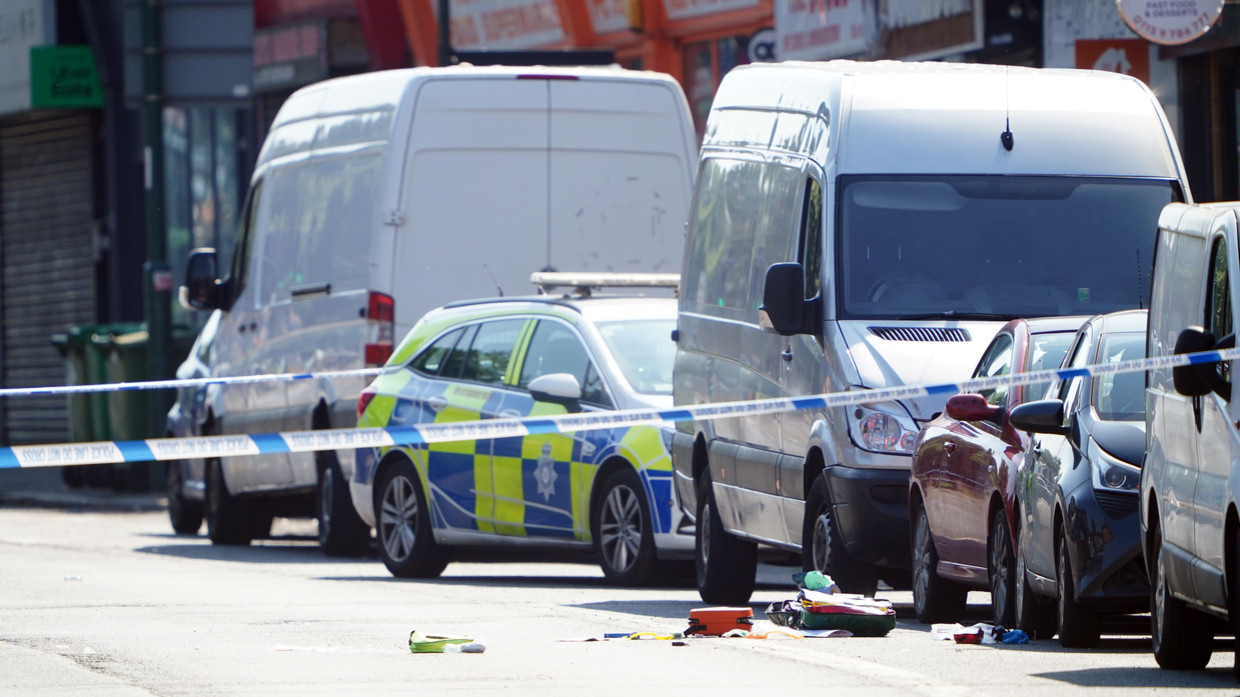
Valdo Calocane, a migrant diagnosed with paranoid schizophrenia who went on a deadly stabbing spree in the UK in 2023, was previously released by mental health workers for fear of being labeled racist, an inquiry into the Nottingham triple murder has heard.

Calocane, who went to the UK from Guinea-Bissau in 2007, fatally stabbed teenage university students Barnaby Webber and Grace O’Malley-Kumar, and another man, Ian Coates, on June 13, 2023. He went on to steal Coates’ van and ran down three pedestrians, leaving them with serious injuries.

On Monday, a public inquiry heard that Calocane was pronounced a paranoid schizophrenic in July 2020 and placed under the care of Nottinghamshire Healthcare NHS Foundation Trust. It transpired that the man, who had failed to turn up to appointments and refused to take his medication, was later discharged by the NHS.

During the proceedings, it also came to light that at one point in 2020, mental health professionals considered isolating the aggressive patient after he attempted to kick down a neighbor’s door. However, the NHS staff decided to release Calocane into the community over concerns related to the “over-representation of young black males in detention,” the inquiry learned. The decision was made despite one psychiatrist warning that “perhaps [he] will end up killing someone.”

On top of that, the bereaved families accused the Nottinghamshire police of attempting to cover up their failures to arrest the paranoid schizophrenic before he went on the deadly stabbing spree.

Calocane had a history of violent assaults as well as stalking and harassment complaints. None of the incidents apparently attracted the police’s attention.

The pedestrian survivors alleged that the local authorities originally told them that they had no prior dealings with Calocane. During the inquiry, however, a representative of the Nottinghamshire police acknowledged that the force had been aware of a series of “unpleasant and antisocial” incidents involving him. The official insisted, however, that “they did not reasonably herald that he would become a triple killer,” and that it was “simply not correct” to suggest a cover-up.

Friday, February 20, 2026

H L GATES PBS SERIES BLACKS AND JEWS - PART3 & 4 - MY REVIEW

  I have enjoyed listening to 4 great orators: first, when I was about 13, I walked across the Airline Bridge to Pelican (baseball stadium) to attend a Billy Graham rally in New Orleans.(1951?)  Seating was segregated, so as not to violate the race laws in the state.  The then young Graham used his knowledge of the Bible with current analogies, at times interrupted by the choir or the powerful voice of George Beverly Shay.  His magnet of salvation caused many to abandon their seats to join the growing mass on the grass who wanted to join up for the Kingdom.  I came near to joining them.     

     On Sunday nights on tv I watched another such speaker, Bishop Fulton J. Sheen.  Because New Orleans was the largest city with only one tv channel, I do not know on which network he appeared.  He was a Roman Catholic bishop, but mixed into his message of religion was politics, especially, oppression of the people in Eastern Europe under Communism.  He was most effective with the use of the pause, which made you think more than him shouting.

     3rd was Ronald Reagan.  In 1960 I had cast my first ballot for President, JFK.  In  1964 I favored LBJ, but not as enthusiastically.  Sen. Goldwater, the Republican candidate, was scheduled to speak at Tulane stadium, and as a TU student, I planned to go, to boo if nothing else.  The crowd was for Goldwater, and Louisiana was one of the few states he would carry in November.  The stadium was enthusiastic for Goldwater.  He spoke.  What a bore!  He might have been giving a report to a Senate committee over trivia.  The crowd waited to erupt; but he never gave them a chance.  Only later in the campaign when I heard the radio address on why vote for Goldwater, delivered by Ronald Reagan, did I appreciate the rhetorric of Reagan.  He did not convince me to vote for Goldwater, but he did get me questioning some of my political assumptions.  Reagan was a great orator.

     4th was unexpected.  I was working in China, and provided a computer, expanding my knowledge of how to use it, etc.  In my exploration, I began to listen to some old speeches of Malcolm X.  I do not mean that I agreed with him.  Malcolm did include some of the bitter contempt for opponents, heard in Elijah Muhammad's or later, Minister Farrakhan's sermons.  But Malcolm's political analyses made one think.  Pause, even without a visual cue to do so.  I am white, and I did not agree, but I could see how others could be readily moved by his speeches.  See Anthony Flood's depiction of the 1961 Black Muslim mass gathering at Uline Arena in Washington. DC, at which the honored guests were George Lincoln Rockwell, leader of the American Nazi Party, he and several members sitting in the audience wearing their uniforms with the red armbands and black swastikas.  From the platform Malcolm spoke friendly words to Rockwell, and Rockwell made a pledge of $20, (perhaps about 7 cartons of cigarettes in those days values).  Malcolm was basically telling the congregants that the good whites were the Nazis.    What could that possibly have to do  with Black-Jewish relations???

     Yet, in the 4-hour program on PBS by Henry Louis Gates, I do not recall seeing Malcolm at all.  What might he have had to do with the topic?  In the early 1960s the Black Muslims held a number of huge gatherings of the faithful for their Founders Day.  A small number of whites were invited guests to these gatherings, and they were not Jews.

http://anthonyflood.com/murraynoifascism.htm

"American Nazi Party Commander George Lincoln Rockwell (center) at a Nation of Islam (NOI) rally, Uline Arena, Washington, DC, June 25, 1961.  During the collection, he shouted: â€Å“George Lincoln Rockwell gives $20!” (almost $135 in today's money).  Malcolm X, noting the applause, asked him: "George Lincoln Rockwell, you got the biggest hand you ever got, didn’t you?”        Elijah Muhammad, NOI founder, invited Rockwell to speak at their next Savior's Day Convention, which he did on Sunday, February 25, 1962, before 12,175 people in Chicago’s International Amphitheater.  (Muhammad Speaks, April 1962, p. 3.)  At the podium, in full Nazi regalia, Rockwell opined â€Å“that Elijah Muhammad is to the so-called Negro what Adolph Hitler is to the German people.  He is the most powerful black man in the country.  Heil Hitler!” (Black History and the Class Struggle, Spartacist League, August 1994, p. 37.)   Anthony Flood"

     MORE TO COME


A Personal Aside - What do Malcolm X, Bernadette Devlin (McAliskey), and I have in common?  By the way, Bernadette Devlin was the leader of the Northern Irland Civil Rights Assn., which in the late 1960s had become militant in demanding equal rights for Roman Catholics in Northern Ireland.  I had gone to Edinburgh to work on my controversial thesis and hopefully receive a doctorate there.  Upon arrival, I was confused by the grafitti on buildings, "Kick the Pope," and "Kick Billy."  I asked.  Billy was King William of Orange, the Protestant Leader who replaced a James II Stuart, after defeating him at the Battle of the Boyne in N. Ireland in 1690.  England remained Anglican, Scotland Puritanical with a RC minority; and Ireland, Protestant with a large RC majority.  It was not until the late 1960s, when I was there that the ABC Cinema became the first movie theater permitted to show films on the Lord's Day.  Pub's were closed on Sundays too, and even closed at 10pm Saturday nights (be up early on the Sabbath to get to the Kirk on time).  A friend, a young man smaller than I, was scouted by a major football team (soccer).  All went well till the final question.  "Do you attend mass on Sunday?"  With yes, he was told they could not have a Roman Catholic on the Ranger's squad.  QUESTION - What do I have in common with Malcolm X and Bernadette Devlin?  Answer - We all were featued speakers at Trotskyist forums in NYC.  Malcolm X sponsored by Militant Labor Forum in Jan. 1965; I was sponsored also by the MLF in Aug. 1966, and Bernadette Devlin (McAliskey) by International Socialist, I think around 1980.  What do I not have in common with Malcolm and Bernadette?  I was not shot.  Malcolm was shot and killed in Feb. 1965.  Bernadette was shot by 3 Ulster Freedom Fighters who invaded her home and she received between 7 and 9 bullets, and lived.  I was not shot or killed.  I had had supper with Bernadette and 4 other university folks at Edinburgh 1969?

    For the record, I was never a member of a Trot political party or of the CP.


 I think it fair to say that Malcolm was NOT in the middle on the Blacks/Jews issues.  He sided with the Nazis as his fave whites.  But Malcolm X is not the only important figure omitted from the PBS series.  Nowhere did I see mention of Harold Cruse.  Cruse wrote a large volume, which in part complains about the dominant influence of Jewish intellectuals inside the Communist Party, USA, which prevented Blacks from establishing their own analysis of their role as a racial minority in the US.  Cruse concedes the importance of the CP, especially in the 1930s, but also the 40s and beyond.  But he sees the CP winning over middle-class Blacks, who are generally interracialists, pushing for integration.  However, by the 1940s Cruse contends, Harlem Blacks not in the middle class, were overwhelmingly segregationists, nationalists.  This was no new division, as in the 1920s the divide between Garvey (and his UNIA) vs. Du Bois and his NAACP.  Cruse implies it is a major lasting divide.  The Communists with their emphasis on the international scene, integration, and following approved moves for minorities, they have abandoned their on analysis, and the essential development of their own culture.  Jewish Communists are responsible for this failing.
     Needless to say, I over simplify, Cruse's view in his 565 page book.  In many ways, I do not aggre with it, but I urge you to read at least one chapter to decide for yourself.  I was teaching at a university, when one morning students pulled down the American flag and replace it at the main entrance with the black, red, and green black liberation flag.  Thence began a student boycott of classes, the Governor, McKeithern, coming to the campus for the first time, and confronting this challenge for the first itme.  I was scheduled to teach that summer, but due to my support of the strike, I was told I was blacklisted.  Have no idea if that was true, just that I never taught in the US again.  Another supporter of the strike, a Lebanese, would be arrested and deported.  But that summer, Black cultural groups began to form in New Orleans.  Before I leave the issue of Black Nationalism, should it be restricted to the US?  What about black support for independence for Black African nations (colonies)?  When Robeson was making films in Britain in the 1930s, he met and befriended some of the extras,  who were students attending British universities.  One was Johnstone Kenyatta, who with Robeson led the British Scottsboro Defence Committee, trying to save the lives of young Blacks accused in Alabama of raping 2 white young women.  A few decades later Johnstone, now known as Jomo, led a Black rebellion against Britain.  Should American Blacks have supported Jomo?  My point - Gates should have mentioned and discussed the important Cruse book, The Crisis of the Negro Intellectual.
     The Gates series rightly stresses the importance of Freedom Summer in Mississippi in the mid-1960s.  The appearance of West Indian Stokely Carmichael and his push for new leadership summarized with the slogan: Black Power.  This electrified the movement.  The phrase was all over the major tv networks and newspapers.  I was then in NYC and bought the Militant (Trot) and the Daily World (CP, heir to the Daily Worker).  Both were small papers. only 6-8 pages.  The Militant coverage was actually similar to the major media's, stress on Black Power, and possible shake-up of the movement.  The DW coverage was also extensive, but I could not find once in the paper the phrase Black Power.  The CP was not on board with this rejection of interracialism at that time.  On board or not, soon whites were expelled from SNCC.  Even the dedicated Dottie Zellner and her husband were about the last whites to be evicted from SNCC, but evicted they were.
     Though it received little fan-fare, New Orleans CORE had basically gone all Black much earlier.  Founded in 1960 and defied the NAACP to stage the first sit-in in the modern era, it remained quite integrated for the first university year.  When some Black young men were giving unwanted attention to some Newcomb gals, they complained, and the Black male CORE leaders told the guys to lay off.  And they did.  Next year, white guys in CORE  were dating Black gals.  The gals did NOT complain, but went out with the white guys.  Oretha Castle, the Black woman then leading NO CORE objected, as did a Black minister.  When election time in CORE came, Oretha managed to disqualify all white males, and only a few white women were allowed to remain as members.  They soon dropped out.  There was no sloganeering of Black Power, but NO CORE was essentially a Black organization by 1962.  LSUNO, unlike the main school in Baton Rouge, had some Black students, and a British socialist professor provided some interracial meetings.  I brought a Black student from Dillard to a meeting of Young Liberals at Tulane, addressed by Rev. Shuttlesworth.  After a few of us went to a pizza place in the Tulane neighborhood, Maple St., and we were denied service.  So began many picketings and protests.  But these were localized, not at all under the old CORE or NAACP umbrellas.
    By the late 1960s, dashikis, Afros, and the biggest thing on tv by Jan. 1977, Alex Haley's Roots, even if it was fiction.

In Part 4 the question of Jews involvement in the slave trade becomes an issue, as the publication of The Secret Relationship between Blacks and Jews stressed the Jews role in the slave trade and slavery.  The Nation of Islam (NOI) was not the first to make such claims.  Henri Pirenne argued that with the fall of the Roman Empire and expansion of Islam into former Christian Africa there rose new merchants - the Jews.  They were particularly involved in the slave trade, and the slaves were Slavs, from whence we derive the word slave.  Arabs would be involved in the African slave trade, and African male slaves to guard harems would of course be castrated.  Indeed, in parts of Asia, to prevent thieving family values, castration might be a qualification for government employment.  Noteworthy, Admiral He, the most important Chinese Admiral who probably gave the PRC its claims to the South China Sea, and who headed a fleet with 30,000 sailors (while Columbus  had about a total of 90 on all 3 ships, sailing 50 years after the Chinese.

     On the role of Jews in the Atlantic slave trade.  I do not know.  But when the Brits attempted to end it, I know of no rioting in the synagogues.  But there was rioting on the slave coasts of West Africa by the African slave traders!  They wanted the lucrative trade to continue.

     Yes, there were Jews in the American South and some owned slaves.  But as conservative politician Leander Perez used to remind the Roman Catholic hierarchy in New Orleans when it began to speak against segregation, the Jesuits had been slave owners too.  The vast majority of Southerners 

were Christians, and many of them were slaveholders.

     Hatred of Jews is often a version of hatred of integration, of mixing races.  Sometimes it is hatred of the other race; sometimes just feeling more relaxed around your own; like being with family.  Can we be friends beyond?  Can they?  Probably sometimes yes, sometimes no.

Hugh Murray


Thursday, February 12, 2026

REVIEW OF H L GATES BLACKS AND JEWS ON PBS ---PART 2

     A Jewish family certainly helped Louie Armstrong when he was young, and I understood, they bought him his first instrument,  An American Army band thay played jazz in Europe during WWI made a powerful impression, and more research might go into intellectuals' reaction to the new music, and that would include Jews.

     Some would contend that jazz began in the cat houses of the NO French Quarter, with musicians playing music to amuse customers and xxx.  Ragtime was popular, but with syncopation and other alterations a new name was required.  When residing in China a decade or so ago, I was surprised to see in a supermarket at the end of a counter a string of condoms; the brand Jiz Bon.  And was reminded of one of the early origins of the term jazz, and its early surroundings.  The American Black Army Band brought the new music to Europe during WWI, to immense popularity.  Also during that war, Pres. Wilson, to protect our young service men, cracked down on the cat houses (something locals would not do), which caused musicians to depart for Kansas, Memphis, Chicago, and New York.  And it was George Gershwin, a Jew, who brought the new music to classical halls.  From humble surroundings to the Stadts Oper in Berlin (where I saw Porgy and Bess).
     A pivotal point is omitted  in Chapter 2 of Gates' series.  For years now, if someone calls you a racist, especially in print, you had better defend yourself or be prepared to lose your job and your standing in most communities.  Yet, there is no law about being a racist.  When did this begin?  In spring 1931 when August Yokinen was brought up on charges of racism.  He was janitor to a Finnish social organization located in Harlem during one of the groups dances.  Two Blacks entered the hall, the band stopped, so did the dancing, and Mr. Yokinen told the two young men to leave.  Yokinen, a member of the Communist Party, USA, was brought up on charges, and a show trial in Harlem was prepared.  Well publicized, many Black newspapers covered the story and hundreds sat in for part of the trial.  Yokinen was not expelled, but had to make up for his racism before being fully restored to membership in the CP.  Meanwhile, US immigration realized that in joining the CP, Yokinenhe  had violated his oath not to try to overthrow the US government, and was deported to eastern Europe.  It was not American law that racism was a crime, but in time the communist policy became de facto law in America.
     Shortly after, the cause celebre of the decade.  Also spring 1931 on a freight train from Chattanooga south, a fight breaks out between young folk hoboing.  Some Blacks won and threw several white boys off the moving train.  They told the sheriff, and to stress their point, - some white girls remained on the train.  Authorities stopped the train, found the girls (or young women), and 9 Blacks.  The women said they were raped, the 9 Blacks quickly put on trial, and so began the Scottsboro Cases.  THE BIGGEST AMERICAN CASE OF THE 1930S.
     The NAACP, not especially interested in low-lifes that would tarnish the organization's reputation, put up a weak defense.  8 were given the death penalty, the 14-year-old got life.  Scottsboro, home of the trials, took pride that no one had been lynched.
     Then, a new kid intervenes, the International Labor Defense, a CP front group, promised to defend the boys, with a 2-pronged approach, excellent attorneys inside the court room, AND agitation, protest, mobilization of masses outside.  The ILD got intellectuals from Europe, including Einstein, Thomas Mann, Kathe Kollwitz, to protest the verdict, marches in Harlem, telegrams from South Africa, an Amerindian chief, Mme. Sun Yet Sen to denounce the Alabama verdict.  The Scottsboro newspaper ran a story that they might have to prepare for a Communist invasion from Chattanooga (presumably a Red center).  The ILD hired a top NY attorney, a non-Communist Jew Samuel Leibowitz to defend the boys.  He was a Democrat, but the other ILD attorneys may have been affiliated with other parties, but some of the were Jewish, too.  
     What were they facing in the 1930s?  Not what you think.  The Supreme Court was so conservative then that Dem. Pres. Franklin openly sought to pack the court with Dems like himself.  And what was that?  PBS had an excellent special on the battle in Wilmington, NC in 1898.  The election had been won by a fusion ticket of Populists and Republicans, and in the South Republican  meant Black.  The Democrats decided to do there what they had been doing ever since the end of the Civil War, certainly since the Republican promise to remove Yankee troops from the South after the disputed 1876 election.  One by one "civilization" was restored by the KKK and similar groups overthrowing black run communities.  By 1898 Wilmington was the last black domino standing, but white Democrats like Josephus Daniels led a physical rebellion, overthrowing the elected government, and ensuring white supremacy and the Democratic Party's Solid South.  When Dem. Woodrow Wilson is elected Pres. in 1912, he soon appoints Josephus Daniels as his Sec. of the Navy.  In some ways Daniels is progressive, opening promotions to ill-educated but intelligent poor whites.  My oncle, who finshed schooling at 5th grade learned on the job to become an engineer on ships.  Same time, Daniels closed the door to Blacks.  Pres. Wilson openly segregates the Civil Service, and  demanding photographs of applicants, and thus not hire Blacks.  As war in Europe looms, the navy grows in importance.  Daniels says America's greatest crime was allowing Blacks to vote.  And who is Undersecretary of the Navy under Daniels.  FDR.  And when FDR becomes President, he keeps the photo requirement, and retains segregation of the Civil Service, AND THE MILITARY.
    How could anyone, much less a Red ILD save the Scottsboro boys?  Their good Jewish attorneys made better arguments up the appeals process, until the US Supreme Court ruled that in a trial with a death penalty, the defense had to have a real legal defender.  A few years later, the ILD and others got another fantastic ruling from the conservative court, Blacks have to be in the pool of possible jurors.  These were possibly the first pro-civil rights rulings by the US Supreme Court since the early days of Reconstruction, and the CP had a hand in these victories.
     The Scottsboro Case was to the 1930s what the Scopes trial, Sacco/Vanzetti, and Loeb/Leopold were to the 1920s.  And the Communists led the way.
    Happily, time is spent on Paul Robeson, probably the best known Black in the world by 1940.  In Europe he made films for African showing (half the continent was British).  He befriended some of the extras in his movies, who were attending universities in Britain.  One was Johnston Kenyatta, and he and Robeson led the Scottsboro Defence organization in Britain.  After WWII, that student became better known back in Africa as Jomo Kenyatta, and led the way to an independent nation. But anti-colonialism for Robeson in the US made him an enemy of the statte.
      I had never heard of Cafe Society and its integrated threats to the un-American activities committees.  HOWEVER, Gates misses the big point - the 1948 election.
     Harry Truman was a typical racist before being elected Pres. AND after.  Only for a short time on the changed international stage did he try to be egalitarian.
     During WWII Hitler offered to let the British continue with their empire; Hitler was aiming eastward.  Indeed, Hitler admired how small Britain had conquered India and other places.  Churchill did not trust Hitler, and thought with American, and even Soviet help, Hitler would lose.  The big 3 was to meet in Potsdam, but FDR died and it was Churchill, Truman, and Stalin.  Soon while meeting still ongoing, Churchill loses the Parliamentary elections to Labour.  Clement Atlee to be the new PM of Britain, and he wants to allow greater India to become independent.  In 1947, with millions dead in disputes of borders, India and Pakistan become independent nations.  Anti-colonialsm, a demand of the communists since the early 1920s, is a new problem to be faced by any American President.  If there are African embassys in Washington, DC, what happens when grand hotels reject their guests, or restaurants request that they go to the back door? 
     Gates discusses Cafe Society in NYC, the first integrated club where notable Blacks were closed to the CP orbit, and they would be called to testify before HUAC, the House Committee on Un-American Activities.  People who took the 5th Amendment, often lost jobs and a place in society.  HUAC helped destroy the Cafe Society and the lives of others round the nation, some of whom were indeed members of the CPUSA.
     Harold Cruse was quite critical of the many Black intellectuals who were in the orbit of the CP.   According to GoogleAI "He was famously critical of Marxism and the American Left, arguing that these ideologies failed to account for the unique "American" character of racism. He particularly targeted Jewish intellectuals in the Communist Party, claiming they had misdirected Black radical energy."  Some of the phrases he used against a Jewish Communist writer of Black history, Herbert Aptheker, made Cruse seem like Dr. Goebels.  Indeed, the issue of Black Fascism is never really mentioned on PBS.  Marcus Garvey, leader of the Universal Negro Improvement Assn. declared "we were the first fascists."  In the early 1960s, Black Muslims invidted as special guests to major BM gatherings members of the American Nazi party in their uniforms with swastika armbands.  Malcolm X spoke directly to the Nazi leader in pleasantries so the mass audience could hear.  Often whites in cartoons in Mohammad Speaks had a hooked nose. showing the evils of integration were pushed by Jews.
     One more thing, a most important one.Time to forget the Dem. propaganda of Truman as the great civil rights President.  1948 was the civil rights movement before the later more successful one.  It centered round the run for the Presidency of a former VP under FDR.  Henry Wallace was VP of the USA from Jan 1941 to Jan. 1945.  Had Franklin Roosevelt died a few months earlier, Wallace would have become Pres. of the USA.  Roosevelt, at the Dem. convention in 1944 had decided to dump Wallace in favor of Truman, and so Truman became Pres. in spring 1945 upon the death of Roosevelt.
     Truman had to learn quickly, about A bombs, the new Labour govt. in Britain, Stalin and his armies in eastern Europe, AND how he might win an election in 1948.  Happily for Truman, he had Clark Clifford, an excellent political strategist, who would recast the mild racist Truman into a civil rights leader, the first President to address the NAACP.  Anti-colonialism was becoming a reality; in 1947 both India and Pakistan became independent.  What happens when an African embassy opens in segregated Washington, DC?  1948 seemed like a shoe in for Republican Tom Dewey, who supported the first civil rights law to be enacted by a state.  Many Southern Dems disliked the trend and bolted from the Truman party to establish the Dixiecrats.  Other Dems bolted from Truman to for the Henry Wallace Progressive Party, which was endorsed by the CP and its friendly trade unions.  I contend, the Wallace campaign in the South was THE civil rights movement of that decade.  Robeson was a leader of the PP.  Dem. Sen Sen. Glen Taylor of Idaho became the VP candidate.  When he went to Birmingham to address the Southern Nego Youth Congress, Police Chief Bull Conner had him arrested for entering the Black entrance to the building.  Neither Robeson, nor Wallace, nor Sen. Glen Taylor, the singing cowboy would appear before segregated audiences.  Many of their meetings had to be in the open, and former VP Wallace was the target of rotten eggs, tomatoes, etc.  There were a few stabbings.  Unlike the later CR movement, tv was too new to have an impact on seeing racism in action.  Truman dismissed the problems as due to Wallace and his communists trying to stir up trouble.  (After he was no longer Pres., Truman said if any sit-in came to his store, he would throw them out.  He also said the Civil War was caused by busy bodies in New England, i.e., the Abolitionists were the cause of the war, not slavery).  But when W E B Du Bois endorse Wallace, not Truman, Du Bois was fired by the NAACP, an organization he helped found.  Truman later had him arrested as a foreign agent.  After Truman's victory, in Feb. 1949, in the NO French Quarter some 60 people were arrested for attending a Progressive Party social that was violating the segregation laws of the state.
     But in 1950 in Washington DC and Baltimore, led my the elderly Black leader Mary Church Terrell, but also including a 4-year old Carl Bernstein, whose mom was a leader of the PP (he would gain fame later as a reporter in the Watergate scandal), they were engaged in a new tactic called sit-downs in restaurants.  These are forgotten,  Too soon. A decade later they will help change America.
EXTRA - I watched the H L Gates series on Blacks and Jews, Parts 3 and 4 on Tuesday night on my local PBS station.  I will review them both, but  in one review.  Extra busy at moment, so I will post it in a few days.  HM


Friday, February 6, 2026

PBS - NEW PROGRAM ON BLACKS AND JEWS BY HENRY LOUIS GATES, JR.

Tonight I was watching a new program, "Black and Jewish American: An Interwoven History," First showings, February 2023, when I saw a short segment on Judah P. Benjamin.  I was shocked!  Did Henry Louis Gates, Jr., get this idea from me?  Did I put something similar on my blog a few years ago?  Or did I get the idea from him in some earlier discussion?  One thing for sure, a few days ago I raised a similar topic for my book.  I will consult with my editor, but if ok, will add a page or 2 on my blog, that you, and Henry L. Gates Jr., might enjoy  Keep tuned.  Hugh Murray

What I had written prior to watching the H L Gates Jr. tv program.  

Chpt. 1, Part 2
     We all learn from our experience, and sometimes cumulative experiences lead us to stereotypes.  Many times they are helpful; sometimes not.  Who was the first American Sec. of State of Jewish heritage?  Henry Kissinger, who was born in Bavaria, Germany and left after the Nazis came to power.  His family settled in Washington Heights in the northern tip of Manhattan.  The neighborhood had many refugees from fascist Europe, and if I recall correctly, the department store just across a small bridge to the Bronx was called a Kaufhaus, or Warenhaus, but my memory may be wrong on that.  Soon after Kissinger, Madeline Albright became the American Sec. of State; she was also of Jewish heritage.
     But there was a practicing Jew who was selected for a Presidential cabinet post, and worked his way up before Kissinger.  He became Sec. of State long before either Kissinger or Albright.  Judah P. Benjamin was the first openly Jewish in his religion to be elected to the US Senate, from Louisiana, then appointed to the Cabinet of Pres. Jefferson Davis of the CSA.  Some say he fled after the war to Britain because as Sec. of State, he may have been in charge of sabotage and assassins.  Because a conspiracy to kill Yankee leaders led to the assassination of then Pres. Lincoln, some may have held resentment toward Benjamin.  At any rate, Benjamin had a most successful career in law in Britain, law rather different from that of Louisiana, which had no English Common Law, but relied as a basis on the Napoleonic Code instead.
     During the  Civil War, officer Ulysses Grant was rising with his victories in the Wester sector.  At one point Gen. Grant was in charge of a large swath of territory, western Kentucky, Tennessee, and other lands near by.  To prevent the Confederates from selling their cotton - Britain had been their main buyer, but the Northern naval blockade prevented that trade.  Grant believed that Jewish businessmen were now trading with the Rebels from his territory. Grant then ordered all Jews in his territory, which was larger then Rhode Island, to get out within 24 hours.  We know he was not reading from a WWII German playbook.  It was perhaps the most anti-Jewish command ever issued in America.  When Lincoln heard of it, he quickly rescinded Grand's order.  But in today's classrooms, one thinks - the North was for freedom and liberal; the South for slavery and reactionary.  The North was sympathetic to minorities like Jews; the South was hostile.  But was it quite like that?
     We call the South the Bible Belt, but Massachusetts began as a very strict puritanical colony.  When the first baby was born, the elders checked the documents for when the couple married, and discovered the baby came too early - the couple must have fornicated BEFORE they were married.  So both husband and wife the first parents in the Mass. Bay colony, were whipped by its leaders.  As the colony grew, the religious leaders found it necessary to rid the area of witches (by killing them) expelling Baptist Roger Williams as his preaching was not sufficient; and the woman preacher Ann Hutchinson  also exiled, both having to depart to Rhode Island (or Rogues Island).  In New England Quaker missionaries were executed.
     In time, there was a major revival led by xxx, raising the religious temperature shortly before the American Revolution.  After the Revolution, when most colonies/states disestablished their various religions (for which all had had to pay taxes), but the Congregational Church in New England remained the established church there until 1830.
     Yet, it was there that a new church began to win converts, the Unitarians.  Unorthodox in many views, they were also influenced by Transcendentalists from Europe, Unitarians, along with Quakers, utopians, and others partook in early communes.  Emerson had at one point been a Unitarian minister; Harvard Divinity was suddenly Unitarian  On a small scale, just as Jews became the intellectuals in NYC from the 1940s - ?, so the Unitarians were the early "Jews" of the Republic, which then had few Jews.
     If you see the film, Glory, about the xxx54th Massachusetts Regimen, an all black one led by the white Col. Shaw, of a prominent Unitarian family in Massachusetts.  They were staunch abolitionists.  Indeed, as late as 1960?, former Pres. Harry Truman was blaming (not slavery) but the New England busy bodies for causing the Civil War.  Democrats called Truman the Civil Rights President, as he was the first to address the NAACP.  When then NAACP employee, W E B Du Bois, refused to endorse Truman in 1948, W E B was promptly fired by the organization he helped organize.

     Image vs. reality.  I was once quite active in the Unitarian Church in my native New Orleans.  It was one of only 2 such churches that survived the war in the South, one in New Orleans and one in Charleston.  Two Unitarian Churches were founded by a prominent figure - the only American to be Vice President to two different Presidents, John C. Calhoun.  When I looked at a Wikipedia article on Unitarians, I urged them to add the name of Calhoun.  Calhoun was not merely prominent, he was a strong defender of slavery, owned many himself, and pushed the notion of nullification to protect "Southern rights."  Nullification was a 19th century term for defying national law, like sanctuary cities and states today.  Today's Unitarians were probably the ones vetoing any discussion of Calhoun and pro-slavery individuals in their abolitionist wiki "history."  Like it or not, Calhoun founded the Unitarian churches in Charleston and Washington, DC.  But today's left wing seeks to cleanse Unitarian history so one reads only of its abolitionist heritage.  I do not deny the importance of abolitionists, but contend it is better to be true to history than to be politically correct.  Abolitionist Unitarians may have been the large majority, but the pro-slavery minority was important, too.
   PS- I had never seen the Confederate money bills with the picture of Judah Benjamin on them.  I did not notice the denomination of the bills.  I guess one can accurately declare, there were Benjamins (for Judah) long before the Benjamin (Franklins) that were made famous by US Rep. Omar's comments in the 21st century.  Indeed, has a Jew ever been pictured on currency of the USA, or is it only in the CSA?  On 7 Sat. 2026 I saw a repeat of the Gates program on a Milwaukee PBS station.  Now I saw clearly, Judah Benjamin appeared on the Confederate $2 bill.  There are some recent scholars (on google AI)  who might contend he should have been on the $3 bill.  If one traveled in the 19th century and had to sleep over, there may not have been enough beds, and men, like Lincoln apparently on many occasions slept in the same bed with another man.  Probably some occasions when 3 in a bed.  There may have been some snuggling, or even playing around, but I think ir wrong to jump to modern conclusions.  Benjamin's case is different; he was married but his wife resided in Paris, where she apparently played around.  Just as modern changes in attitude toward views of slave owners meant a lower approval rating for John Calhoun, it may be the reason for new questions about Judah Benjamin.  Another reason I am skeptical of the recent speculation that Benjamin was gay - because he was a Jew, he would have come under more scrutiny at the time, especially by wives of those of who were jealous of his position.  Rumor, gossip, can have a powerful effect, ir true, and sometimes if not true.  That the "brains of the Confederacy" or Pres. Davis's "pet Jew" was not fired but promoted seems to work against the supposition of some modern historians.
     There are fashions in history just as there are in women's skirts.  Some may help us to discover truths that contradict the old story; and some that may confuse the issue even more.
      Liberal North, reactionary South.  Recall the draft riots in NYC, beginning in mid-July 1863, working-class whites, mainly Irish, resented a new law exempting those rich enough to pay $300 to be exempt from the draft.  They also resented going to fight to free blacks who would then become competitors with them for jobs.  5-days of burning homes of the rich, and a black orphanage, and attacks killing up to 1,200 people, and stopped only withthe arrival of 4,000 Yankee troops who had just left Gettysburg.  It is easier to write about the good guys vs. the bad, but . . .
   Tonight I watched Part 2 of the H L Gates PBS Series on Blacks and Jews..  I hoped to write a review, but I received an injection in my right eyeball today, and the computer light is too strong - I am crying,  I should have a review up soon of Part 2.
